A History of Open-World Action Games: From Elite to Grand Theft Auto III and Beyond
How open-world action games evolved, from Elite and Mercenary in the 1980s through GTA III's 3D city in 2001 to the sandbox boom and the Red Dead 2 era.
Today the open world is one of the dominant structures in big-budget games. But the idea of a large space you can explore freely, choosing your own route and pace, is far older than modern blockbusters. It grew out of space trading games on 8-bit computers, experimental 3D sandboxes on 16-bit machines, and late-1990s console games that tried to build living cities. Then, in 2001, Grand Theft Auto III turned those ideas into a mainstream formula that defined the next two decades.
This history traces the open-world action game from its early roots to the present. It skips Nintendo’s own series, which are covered elsewhere, and focuses on the games and studios most relevant to open-world action-adventures. Dates are given as verified release years; where “firsts” are debated, the article avoids claiming them.
The 1980s: open space on home computers
Elite (1984)
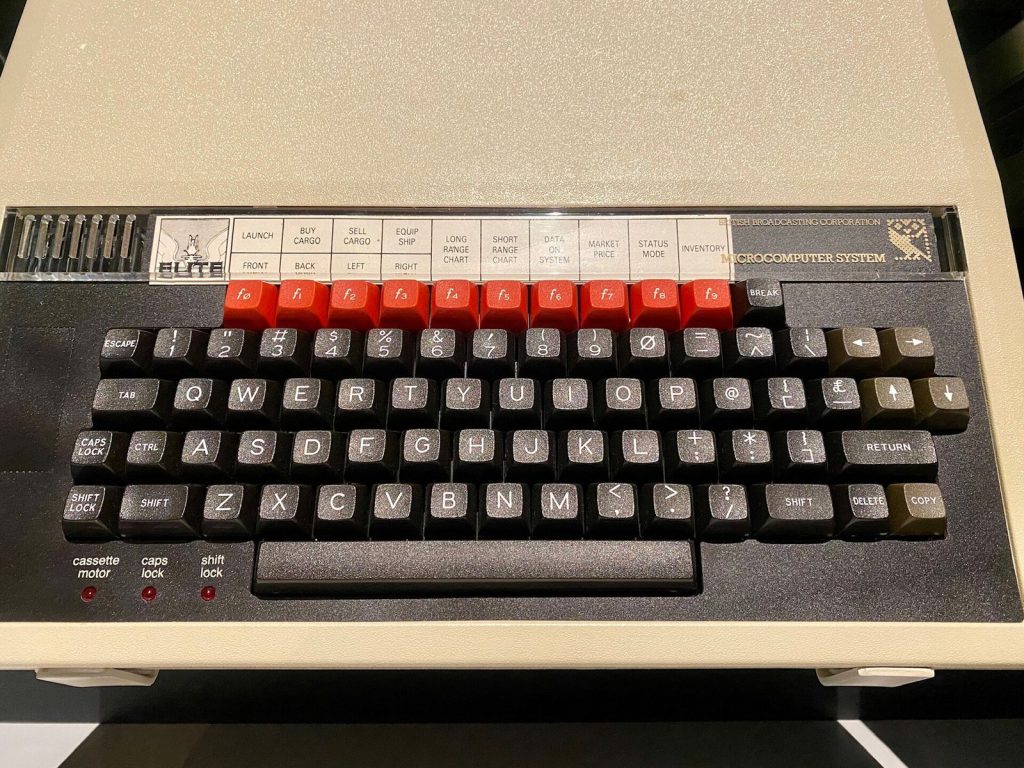
Elite, created by David Braben and Ian Bell and first published by Acornsoft for the BBC Micro in 1984, is often cited as a foundational open-ended game. It placed players in a wireframe 3D galaxy of hundreds of star systems and let them decide how to make a living — trading, bounty hunting, piracy or mining — with no fixed path. Its influence on space games is enormous, but its core idea, a world you navigate according to your own goals, also anticipated open-world design more broadly.
Mercenary (1985)
Novagen’s Mercenary, designed by Paul Woakes and released in 1985 for the Atari 8-bit computers before being ported widely, took that freedom down to a planet’s surface. You crash-land on the planet Targ, where two factions are at war, and explore a sparse vector-graphics world in real time on foot and in vehicles. You can work for either side or play them against each other, and there are several ways to escape the planet. Retrospectives frequently point to Mercenary as an early example of non-linear, explorable 3D worlds.
These games were limited by hardware — sparse environments, simple graphics — but they established that a game could give the player a world rather than a sequence of levels.
The early 1990s: 3D sandboxes take shape
Hunter (1991)
Hunter, published by Activision in 1991 for the Amiga and Atari ST, is one of the most interesting precursors to modern action sandboxes. Designed and programmed by Paul Holmes, it featured a 3D landscape of islands, hills and lakes where players could walk, swim, or drive vehicles including cars, tanks and even surfboards, and could enter buildings. Missions could be tackled with considerable freedom. Reviewers at the time praised that openness, and later commentators have compared its sandbox style to Grand Theft Auto and Far Cry 2.
The 16-bit era generally lacked the power to make such worlds dense or detailed, but games like Hunter showed what a vehicle-based 3D sandbox could feel like.
The late 1990s: cities, cars and consoles
Grand Theft Auto (1997)
The original Grand Theft Auto, developed by Scotland’s DMA Design and released in 1997, used a top-down perspective to present entire cities full of cars, pedestrians and police. You took jobs from crime bosses via payphones, but you could ignore missions and simply drive, steal and cause chaos. Its controversial content attracted attention, but its open city structure was the important design lesson. Our GTA order guide covers the full sequence of releases from that point on.
Body Harvest (1998)
Before GTA III, DMA Design also made Body Harvest, released for the Nintendo 64 in 1998. It is an alien-invasion action game set across several large 3D regions, where the player can commandeer dozens of vehicles. It is often mentioned as an important experiment in 3D vehicle-based open spaces from the studio that would become Rockstar North.
Driver (1999)
Reflections Interactive’s Driver, released in 1999, put players in the role of an undercover cop driving through detailed recreations of cities including Miami and San Francisco. Its free-roaming “Take a Ride” mode and its 1970s car-chase-movie feel made driving through a 3D city the main attraction — something GTA III would soon combine with on-foot action.
Shenmue (1999)
Sega’s Shenmue, directed by Yu Suzuki and released in Japan for the Dreamcast in December 1999, took a different approach. Rather than mayhem, it focused on everyday life in a carefully simulated Japanese town in the 1980s: shops with opening hours, residents with routines, weather, and a day-night cycle. It was enormously ambitious and expensive, and its slow pace divided players, but its emphasis on a living, reactive world influenced many later designers.
2001: Grand Theft Auto III changes everything
Grand Theft Auto III, released for the PlayStation 2 in October 2001, combined the ideas that had been developing for years into one package. It presented Liberty City as a fully 3D city that you could explore seamlessly, on foot or in any vehicle, with radio stations, pedestrians, traffic and police. It mixed story missions with side activities such as taxi, ambulance and vigilante jobs, and allowed players to cause emergent chaos whenever they wanted.
What made GTA III so influential was not any single feature but the combination: a continuous 3D city, a mission-driven story, a wanted system that escalated in response to your behavior, and the freedom to ignore all of it. It became one of the best-selling games of its era and set the template that publishers spent the next decade imitating. That basic structure — main missions plus optional activities plus systemic chaos — is what our open-world genre explainer describes as the heart of the genre.
Rockstar followed quickly with Vice City (2002) and San Andreas (2004), the latter expanding to an entire fictional state with three cities and countryside between them.
The 2000s sandbox boom
In GTA III’s wake, many studios built open-world action games, often labeled “GTA clones” at the time but frequently adding ideas of their own:
- Mafia (2002) from Illusion Softworks recreated a 1930s American city with an emphasis on narrative and period detail.
- The Getaway (2002) from Sony’s Team Soho modeled central London and removed traditional HUD elements.
- True Crime: Streets of LA (2003) put players on the side of the law in a recreation of Los Angeles.
- Spider-Man 2 (2004), developed by Treyarch, let players web-swing freely around Manhattan and is often credited with showing how traversal could carry an open world.
- Mercenaries (2005) from Pandemic brought destructible military sandboxes to a fictional conflict in North Korea.
- Just Cause (2006) and Saints Row (2006) pushed toward spectacle and humor, respectively.
- Crackdown (2007) built progression around collecting agility orbs to climb a vertical city.
In 2007, Ubisoft’s Assassin’s Creed brought the open-world structure to historical cities with parkour traversal and social stealth, while Far Cry 2 (2008) took the series to an open African landscape with fire propagation and harsh survival elements. Rockstar’s own GTA IV (2008) moved to a more grounded tone, and Red Dead Redemption (2010) applied the formula to the American frontier with great success.
The 2010s: the Ubisoft formula and its critics
By the early 2010s, a recognizable structure had emerged, particularly in Ubisoft’s games: a large map divided into regions, towers or viewpoints that revealed each area, many icon-marked activities, and outposts or strongholds to liberate. Far Cry 3 (2012) and the Assassin’s Creed games of that period are the best-known examples. The structure was effective at providing constant activity, and many games across the industry adopted variations.
It also drew criticism for repetitive checklists and maps cluttered with icons. Our article on open-world map design explains how towers, fog and icons work and why the industry gradually shifted away from them.
Meanwhile, Grand Theft Auto V (2013) brought three playable protagonists and a huge version of Los Santos and its surrounding countryside, becoming one of the best-selling games of all time. Other notable entries of the decade include Sleeping Dogs (2012), Watch Dogs (2014), Metal Gear Solid V: The Phantom Pain (2015), which moved Konami’s stealth series to open maps, and Assassin’s Creed Origins (2017), which rebuilt the series around larger regions and character progression.
The Red Dead 2 era: density, detail and restraint
Red Dead Redemption 2, released in October 2018, is often seen as a high-water mark for open-world detail. Its world is packed with handcrafted encounters, animals with ecosystems, camps that react to your behavior, and characters who remember you. Crucially, it relies less on map icons and towers, encouraging exploration through landmarks, random encounters and conversation.
The same year, Insomniac’s Marvel’s Spider-Man brought the traversal-first approach of Spider-Man 2 into the modern era, and Assassin’s Creed Odyssey offered an Exploration Mode that removed precise markers. Later games continued to experiment with how much guidance to provide, with many offering HUD options so players can choose for themselves.
As of this writing in October 2026, the next major milestone the genre is waiting for is Rockstar’s Grand Theft Auto VI, set in the fictional state of Leonida and currently scheduled for release on November 19, 2026, for PlayStation 5 and Xbox Series X|S.
Recurring themes across 40 years
Looking back across four decades, a few ideas recur:
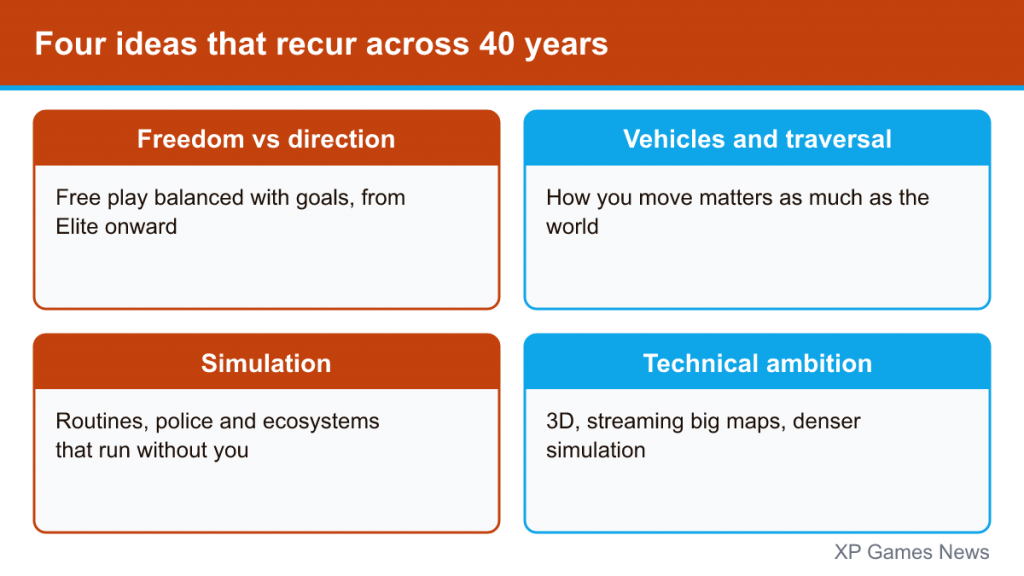
- Freedom versus direction. From Elite onward, designers have balanced letting players do what they want against keeping them engaged with goals.
- Vehicles and traversal. Hunter, Driver, GTA III and Spider-Man 2 all show that how you move through a world is as important as what is in it.
- Simulation and reactivity. Shenmue’s routines, GTA’s police and Red Dead 2’s ecosystems all make the world feel like it exists without you.
- Technical ambition. Each step forward was tied to hardware — 3D rendering, streaming large maps from disc, and denser simulation.
The open-world action game did not come from a single invention but from many experiments on many platforms. GTA III remains the turning point that made it mainstream, but its roots go back to a wireframe galaxy on a 1984 home computer.