Grand Theft Auto Games in Order: Every Main Game and Where to Start
Every main Grand Theft Auto game in release order, the handheld entries, the 2D, 3D and HD universes, and which GTA a newcomer should play first.
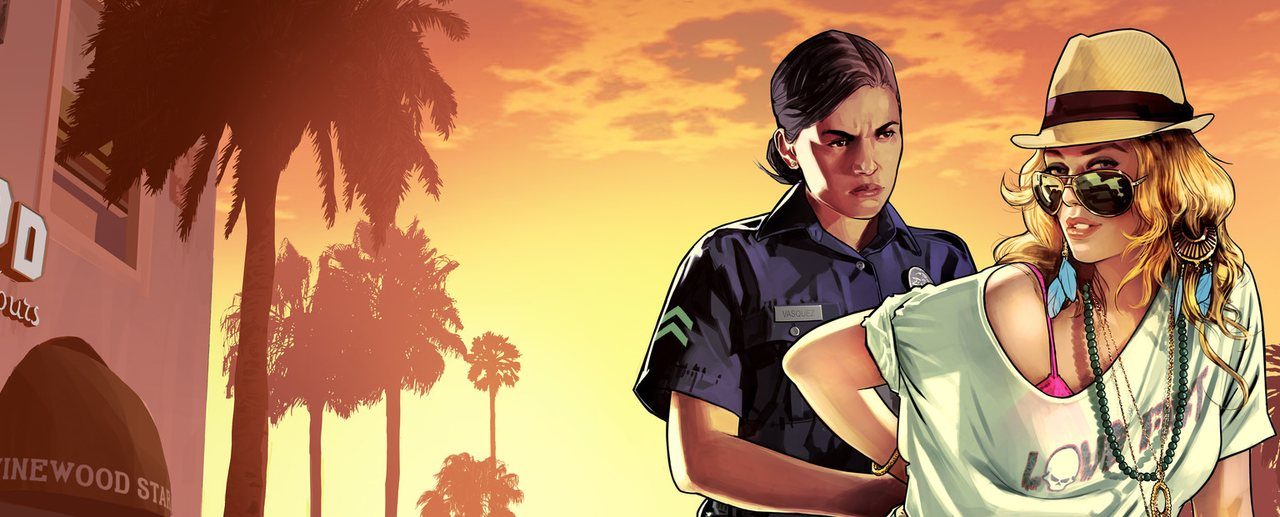
Grand Theft Auto has been around since 1997, and in that time it has gone from a top-down crime game made in Scotland to one of the defining series in the open-world action-adventure genre. With more than a dozen games, expansions and handheld spin-offs, plus three separate fictional continuities, the order can be confusing. This guide lists every main release, explains how the universes fit together, and suggests where a newcomer should begin. The focus is on the single-player story games, not GTA Online.
Every main Grand Theft Auto game in release order
The table below covers the numbered and named mainline entries plus their expansions, in order of first release.

| Year | Game | Setting | Original platforms |
|---|---|---|---|
| 1997 | Grand Theft Auto | Liberty City, San Andreas, Vice City (2D versions) | PC (MS-DOS/Windows), PlayStation |
| 1999 | Grand Theft Auto: London 1969 (expansion) | London | PC, PlayStation |
| 1999 | Grand Theft Auto: London 1961 (expansion) | London | PC |
| 1999 | Grand Theft Auto 2 | Anywhere City | PC, PlayStation, Dreamcast |
| 2001 | Grand Theft Auto III | Liberty City | PlayStation 2 |
| 2002 | Grand Theft Auto: Vice City | Vice City | PlayStation 2 |
| 2004 | Grand Theft Auto: San Andreas | San Andreas (Los Santos, San Fierro, Las Venturas) | PlayStation 2 |
| 2008 | Grand Theft Auto IV | Liberty City | PlayStation 3, Xbox 360 |
| 2009 | GTA IV: The Lost and Damned (episode) | Liberty City | Xbox 360 |
| 2009 | GTA IV: The Ballad of Gay Tony (episode) | Liberty City | Xbox 360 |
| 2013 | Grand Theft Auto V | Los Santos and Blaine County | PlayStation 3, Xbox 360 |
| Scheduled | Grand Theft Auto VI | Leonida, including Vice City | PlayStation 5, Xbox Series X|S |
Most of these games were later ported to other platforms. PC versions of the 3D-era games followed their console launches, the GTA IV episodes reached PlayStation 3 and PC, and Grand Theft Auto V has been released on three console generations, including PlayStation 5 and Xbox Series X|S versions in 2022.
The handheld and portable entries
Rockstar also produced several games for portable systems. They are not required to understand the main series, but some are excellent in their own right.
- Grand Theft Auto Advance (2004) – A top-down game for the Game Boy Advance, set in Liberty City as a prequel to GTA III. It was developed by Digital Eclipse.
- Grand Theft Auto: Liberty City Stories (2005) – A full 3D game originally for the PSP, later ported to PlayStation 2. It follows Toni Cipriani, a character from GTA III, in the Liberty City of 1998.
- Grand Theft Auto: Vice City Stories (2006) – Another PSP game later released on PlayStation 2, set in Vice City in 1984, two years before Vice City.
- Grand Theft Auto: Chinatown Wars (2009) – Originally released for the Nintendo DS, then on PSP and mobile. It returns to an angled top-down view and is set in the HD-era Liberty City.
There were also Game Boy Color versions of the first two games in the late 1990s.
The three universes: 2D, 3D and HD
Grand Theft Auto is not one continuous timeline. Rockstar treats the games as belonging to separate continuities, which fans name after the graphical era of each group:
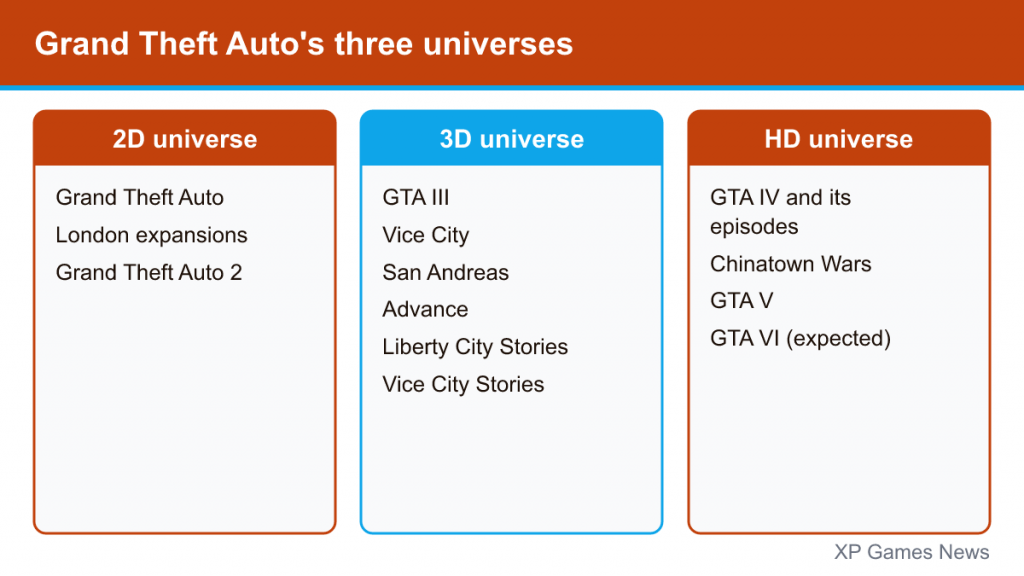
- 2D universe: Grand Theft Auto, the London expansions and Grand Theft Auto 2.
- 3D universe: Grand Theft Auto III, Vice City, San Andreas, Advance, Liberty City Stories and Vice City Stories.
- HD universe: Grand Theft Auto IV and its episodes, Chinatown Wars, and Grand Theft Auto V. Grand Theft Auto VI is expected to belong to this era as well.
This explains why the same city names appear in different forms. The Liberty City of GTA III and the Liberty City of GTA IV are both inspired by New York, but they are different maps in different continuities. The same is true of Los Santos: San Andreas featured a version within a three-city state, while GTA V rebuilt Los Santos in much greater detail as its main city.
Characters do not cross between universes. Within a universe, though, connections are common. Toni Cipriani and Salvatore Leone appear in both GTA III and Liberty City Stories, and several characters from Vice City Stories reappear in Vice City.
3D universe in story order
If you want to play the 3D-era games in the order the events happen, here is the internal chronology:
- Vice City Stories – 1984
- Vice City – 1986, following Tommy Vercetti
- San Andreas – 1992, following Carl “CJ” Johnson
- Liberty City Stories – 1998
- Grand Theft Auto Advance – 2000
- Grand Theft Auto III – 2001, following the silent protagonist Claude
Playing in this order lets you meet some characters before their later appearances, but it also means starting with the PSP-era games, which feel more limited than the console releases. For most people, release order is the better experience, because each game builds on its predecessor’s mechanics.
HD universe in story order
The HD era is simpler. Grand Theft Auto IV, The Lost and Damned and The Ballad of Gay Tony take place at roughly the same time in Liberty City, and their stories intersect: the three protagonists, Niko Bellic, Johnny Klebitz and Luis Lopez, cross paths during a shared diamond deal. Chinatown Wars is also set in Liberty City. Grand Theft Auto V follows Michael De Santa, Franklin Clinton and Trevor Philips in Los Santos and contains a few nods to events and characters from GTA IV and its episodes, but it can be enjoyed entirely on its own.
What each main game is known for
Grand Theft Auto (1997) and Grand Theft Auto 2 (1999)
Developed by DMA Design, the studio that became Rockstar North, the originals were top-down games about stealing cars and completing jobs for criminal bosses. They established the series’ satirical tone and police response. GTA 2 added gang respect, where working for one gang made rivals hostile.
Grand Theft Auto III (2001)
The leap to a full 3D city on PlayStation 2 is the moment most players associate with the modern series. Radio stations, story missions given by a range of crime bosses, side activities and a city you could explore freely became the template for years to come.
Vice City (2002)
A 1980s Miami-inspired setting gave the series a strong identity and a memorable protagonist with a voice, Tommy Vercetti. The game added motorcycles, helicopters and property purchases that generated income.
San Andreas (2004)
The most ambitious 3D-era game spread across three cities and countryside. It added character stats like stamina and driving skill, customization, gang territory battles, and a very long campaign.
Grand Theft Auto IV (2008)
The first HD game took a more grounded, serious tone, following Eastern European immigrant Niko Bellic. It introduced heavier vehicle handling and physics-driven character animation, and its two episodes offered biker and nightlife-focused stories.
Grand Theft Auto V (2013)
GTA V introduced three playable protagonists whose stories intertwine, with the ability to switch between them, and built its campaign around planned heists. It remains one of the best-selling games of all time.
Grand Theft Auto VI: what has been announced
Rockstar officially revealed Grand Theft Auto VI with a trailer in December 2023. The game is set in the fictional state of Leonida, which includes a modern Vice City, and features a pair of protagonists, Lucia and Jason. It was originally targeted for 2025, then delayed. As of the latest Take-Two statements before this guide was written, it was scheduled for November 19, 2026 on PlayStation 5 and Xbox Series X|S. Release plans can change, so check Rockstar’s official site for the current status.
Where should a newcomer start?
There is no single right answer, but here are the most common recommendations depending on what you want.
- You want the modern experience: Start with Grand Theft Auto V. It has the most polished controls, it is easy to find on current platforms, and its story requires no prior knowledge.
- You want a strong, focused story: Grand Theft Auto IV and its two episodes form a tight, interconnected tale. The tone is darker and the driving heavier, which some players love and others find demanding.
- You want to see the series’ roots: Try GTA III, Vice City and San Andreas in order. They are available in remastered form as Grand Theft Auto: The Trilogy – The Definitive Edition (2021), which updates graphics and controls. Some players prefer the original versions, which are less widely available.
- You want something portable or shorter: Chinatown Wars is a compact game with a lot of personality.
A practical suggestion for someone new to the series: play GTA V first, then go back to GTA IV and San Andreas if you enjoy it. Starting with the oldest games can be off-putting because their controls and save systems feel dated, while starting with GTA V gives you a sense of what the series does best.
Common questions
Do I need to play the games in order? No. Each main game tells a self-contained story. Recurring characters and references reward long-time players but are never essential.
Is GTA Online part of the story? GTA Online is a separate multiplayer mode set in the GTA V world. It is not required for the story mode, and it is outside the scope of this guide.
Which game is the longest? San Andreas and GTA V both have large campaigns. Exact length depends on how much side content you do.
Are the London games worth playing? They are mainly of historical interest today. They show the series’ British roots but feel very basic compared to later entries.