A History of Stealth Games: From Castle Wolfenstein to Hitman
How stealth games evolved: early experiments like Castle Wolfenstein, Metal Gear in 1987, the 1998 breakthrough year, and the rise of sandbox stealth.

Most action games reward you for confronting enemies. Stealth games reward you for avoiding them — or for removing them so quietly that no one notices. That simple inversion has produced some of the most distinctive games ever made, from Metal Gear Solid’s cardboard boxes to Hitman’s disguises and Thief’s pools of shadow. The genre took a long time to coalesce, though. Its history runs from early computer and arcade experiments to a remarkable cluster of releases in 1998, and from there into the sandbox and immersive-sim designs that dominate stealth today.
This article traces that history with verified dates and developers. Where a game is commonly called “the first” of something, the claim is attributed rather than stated as fact, because “first” debates in game history are rarely settled.
Early experiments (1979–1986)
The idea of avoiding an enemy’s line of sight appeared surprisingly early. Several small games from the late 1970s and early 1980s are cited as precursors:
- Manbiki Shounen (1979), a Japanese computer game by Hiroshi Suzuki, asked players to shoplift without being seen by the store owner, and is often cited as the earliest stealth game.
- Lupin III (1980), a Taito arcade game, built on that idea.
- 005 (1981), a Sega arcade game, is recognized by Guinness World Records as the first stealth game. Players had to carry a briefcase through a warehouse while avoiding searchlights and guards.
Castle Wolfenstein (1981)
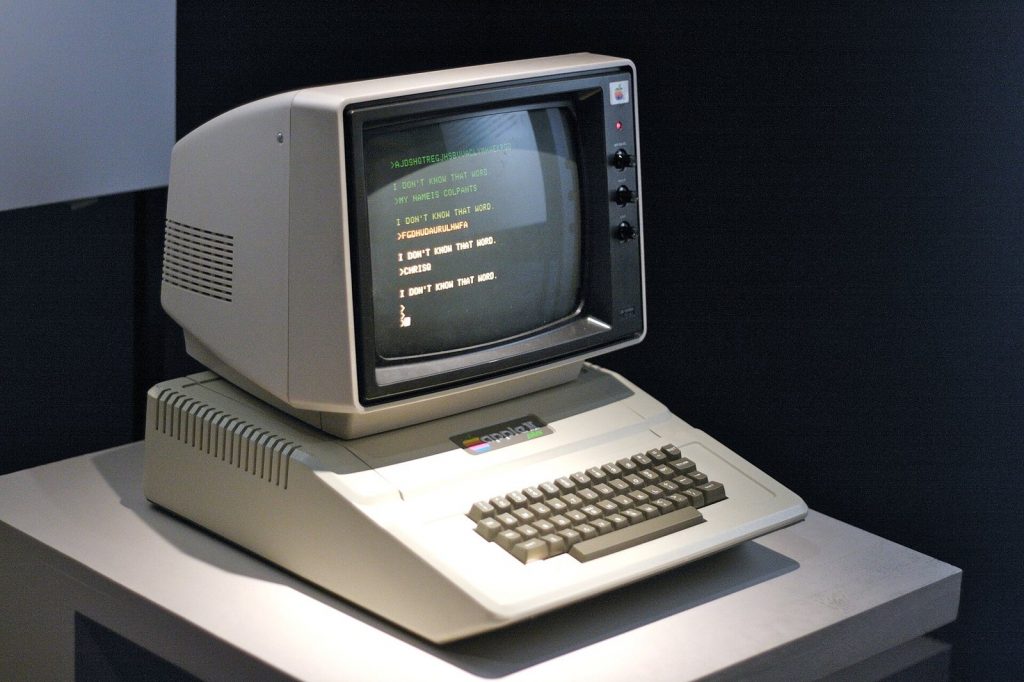
The most influential early computer stealth game was Castle Wolfenstein, created by Silas Warner and published by Muse Software for the Apple II in 1981. Set in a Nazi castle during World War II, it tasked players with escaping and finding secret plans. Crucially, you could deal with guards by sneaking, killing or impersonation: a uniform found in one of the castle’s chests let you walk past ordinary soldiers unnoticed, though not the SS — an early form of disguise. A sequel, Beyond Castle Wolfenstein, followed in 1984.
The name later became famous for a very different reason: id Software’s Wolfenstein 3D (1992) reimagined the setting as a fast first-person shooter and largely abandoned stealth, helping to define the action shooter instead.
Metal Gear and the birth of tactical espionage (1987–1990)
The genre’s most important early milestone came from Konami. Metal Gear, designed by Hideo Kojima, was released in Japan for the MSX2 computer in 1987, with a substantially different NES version released in 1988. Players controlled Solid Snake, infiltrating an enemy fortress to destroy a nuclear-armed walking tank. Because the hardware limited how many enemies could be shown, Kojima’s team built the game around avoiding guards rather than fighting them — a constraint that became the series’ identity.
Metal Gear 2: Solid Snake (1990, MSX2) refined the formula significantly. Guards had a wider field of view, could hear noises and moved between screens, and an alert system made enemies search for you after you were spotted. These ideas — vision, sound, alert phases — remain the basis of stealth design. Our Metal Gear Solid play-order guide explains how those early games fit into the larger saga.
Other games of the era also experimented with stealth elements, including Infogrames’ Hostages (1988), which used searchlight evasion and cover. But it was Metal Gear’s design philosophy that would echo most loudly.
1998: the breakthrough year
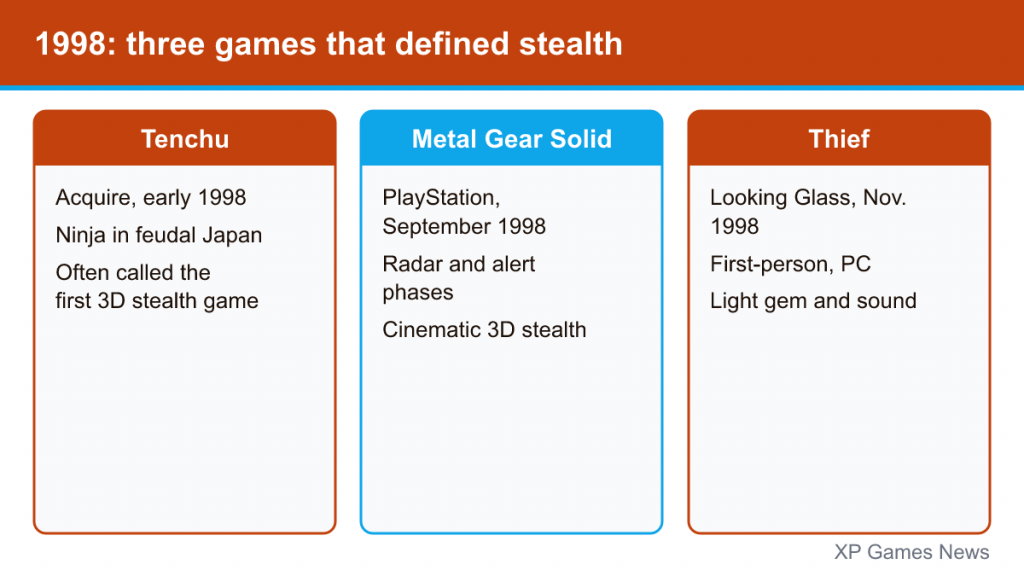
Three games released within the same year are generally credited with establishing stealth as a recognized genre of its own. Each approached it differently.
Tenchu: Stealth Assassins
Developed by Acquire and released in Japan in early 1998, Tenchu put players in the role of ninja in feudal Japan. It was a fully 3D game built around sneaking, rooftop movement with a grappling hook, and silent kills from hiding. A “ki meter” indicated the proximity and awareness of nearby enemies. Tenchu is commonly described as the first 3D stealth game.
Metal Gear Solid
Released in Japan in September 1998 for the PlayStation, and internationally in the following months, Metal Gear Solid brought Kojima’s series into 3D with a cinematic presentation, extensive voice acting and a story full of memorable bosses. It was a major commercial and critical success and introduced many players worldwide to the idea of stealth as a central mechanic. Its radar, alert phases and inventive tools — including the famous cardboard box — made stealth accessible and playful.
Thief: The Dark Project
Looking Glass Studios’ Thief: The Dark Project, released for PC in November 1998, took stealth to first person. As the master thief Garrett, you relied on a “light gem” showing how visible you were and on sound — footsteps on tile were louder than on carpet. Water arrows extinguished torches and moss arrows muffled your steps. Thief is widely regarded as the first first-person stealth game and the origin of the light-and-shadow subgenre.
Also in 1998, Pyro Studios’ Commandos: Behind Enemy Lines brought stealth into real-time tactics, showing enemy vision cones from above.
The 2000s: assassins, spies and sequels
The years after 1998 saw stealth spread and diversify.
Hitman: Codename 47 (2000)
Danish studio IO Interactive released Hitman: Codename 47 in 2000. It introduced Agent 47, a cloned assassin, and a design centered on infiltrating a location, taking disguises from defeated people, and eliminating targets quietly. Hitman popularized disguises in 3D stealth and, over the following decade, developed its sandbox structure through Silent Assassin (2002), Contracts (2004) and Blood Money (2006). Blood Money introduced a notoriety system that punished messy work by making 47 more recognizable in later missions.
Deus Ex and the immersive sim (2000)
Ion Storm’s Deus Ex (2000), led by Warren Spector, was not a pure stealth game, but it let players choose between stealth, combat, hacking and conversation in open-ended levels. Together with Thief, it laid the foundations of the immersive sim, a tradition that later produced Dishonored.
Splinter Cell (2002)
Ubisoft Montreal’s Tom Clancy’s Splinter Cell (2002) adapted Thief’s light-and-shadow approach to a modern spy thriller, with a light meter, night-vision goggles and gadgets. With Chaos Theory (2005), it reached what many consider the peak of classic stealth design, adding a sound meter that compared player noise to ambient noise. The full series is covered in our Splinter Cell series guide.
Metal Gear Solid sequels
Metal Gear Solid 2: Sons of Liberty (2001) added new moves and more sophisticated AI, while Metal Gear Solid 3: Snake Eater (2004) moved to a jungle setting and introduced a camouflage index, showing how well Snake blended into his surroundings.
Social stealth
Ubisoft’s Assassin’s Creed (2007) popularized social stealth: hiding not in shadows but in crowds, blending with groups of monks or sitting on benches. The approach became central to how millions of players encountered stealth, even in games that were not primarily stealth titles.
The 2010s: immersive sims and open maps
Stealth design in the 2010s broadly moved in two directions: deeper systems and bigger spaces.
The immersive-sim revival
Arkane Studios’ Dishonored (2012) brought the immersive-sim tradition to a new generation with supernatural powers such as Blink, levels with many routes, and a chaos system that tracked violence. Deus Ex: Human Revolution (2011) and Mankind Divided (2016) continued that line. These games treated stealth as one of several valid approaches rather than a requirement, and they often rewarded non-lethal play.
2D and readable stealth
Klei Entertainment’s Mark of the Ninja (2012) showed how much stealth could gain from clear information. Its 2D side-scrolling view visualized sound as expanding rings and made vision cones and lighting explicit, making the genre’s rules unusually readable.
Modern action-stealth
Splinter Cell: Conviction (2010) and Blacklist (2013) introduced faster “predator” stealth with Mark and Execute, while Rocksteady’s Batman: Arkham Asylum (2009) and its sequels popularized predator rooms where players stalked armed enemies from above.
Open-world and sandbox stealth
Metal Gear Solid V: The Phantom Pain (2015) placed stealth in large open maps where you could approach outposts from any direction, at any time of day, with a range of buddies and tools. The following year, IO Interactive’s Hitman (2016) reboot launched episodically and turned each location into a dense sandbox with multiple targets, scripted Mission Stories and huge replay value. Its sequels Hitman 2 (2018) and Hitman 3 (2021) built on that structure, and the three games’ locations were later unified under the name Hitman: World of Assassination.
What stealth games have in common
Across 40-plus years, the same core ideas recur:
- Information asymmetry. The player usually knows more than the guards — through radar, Dark Vision, Instinct or a top-down view — and uses that knowledge to plan.
- Readable rules. Vision cones, light meters and sound indicators exist so the player understands why they were seen.
- Escalating alertness. From Metal Gear 2’s alert phases onward, guards move from unaware to suspicious to searching to combat.
- Multiple solutions. The best stealth games offer several valid routes and tools, encouraging experimentation and replays.
These principles connect the earliest experiments to today’s sandbox games. For an overview of how they map onto the genre’s different subgenres, see our explainer on what makes a stealth game.
Where the genre stands today
In recent years, stealth has remained a vital part of the action landscape. Hitman: World of Assassination has continued to receive updates, Assassin’s Creed Mirage (2023) returned that series to a more stealth-focused structure, and Assassin’s Creed Shadows (2025) built one of its two protagonists around light, shadow and infiltration. Konami’s Metal Gear Solid Delta: Snake Eater (2025) remade one of the genre’s classics for a new generation. Ubisoft has also announced a remake of the original Splinter Cell, which remains in development without a release date as of October 2026.
The tools have changed enormously since a Sega arcade cabinet asked players to dodge searchlights, but the fundamental appeal is the same: the tension of being unseen, and the satisfaction of a plan that works.