How Wanted Levels and Police Systems Work in Open-World Games
How wanted stars, bounties, notoriety and heat work in GTA, Red Dead 2, Assassin's Creed and Watch Dogs, and the common logic behind escaping the law.

One of the defining features of an open-world action game is that the world reacts when you break its rules. Run someone over in a city and a siren is never far away; rob a train in the Old West and your face may end up on a poster. These police and law systems — wanted stars, bounties, notoriety, heat — are what make a sandbox feel like a society rather than a playground with no consequences.
Different series implement the idea in very different ways, but they share a common logic: crimes are noticed, a response escalates, and the player has to break contact or settle the debt to return to normal. This guide explains how the major systems work in Grand Theft Auto, Red Dead Redemption 2, Assassin’s Creed and Watch Dogs, keeping to well-documented mechanics rather than exact internal thresholds, which can vary by version and situation.
The basic loop: notice, escalate, escape
Almost every open-world law system can be broken into the same stages:
- Detection. A crime has to be seen or reported. Some games react instantly to any crime near police; others require witnesses.
- Escalation. The response grows with the severity of your actions and how long you resist — more officers, faster vehicles, better-armed units.
- Pursuit and search. Police chase you while they can see you, then switch to searching an area once they lose sight.
- Resolution. You escape the search, pay a penalty, change your appearance, or are arrested or killed.
If that sounds similar to stealth games, it is. The idea of enemies who switch from “searching” to “lost contact” is the same alert-state logic discussed in our article on enemy detection in stealth games, scaled up to an entire city.
Grand Theft Auto: the star system
The wanted level is most closely associated with Grand Theft Auto, where it is displayed as a row of stars. The more stars, the more serious the police response.
The 3D-era games
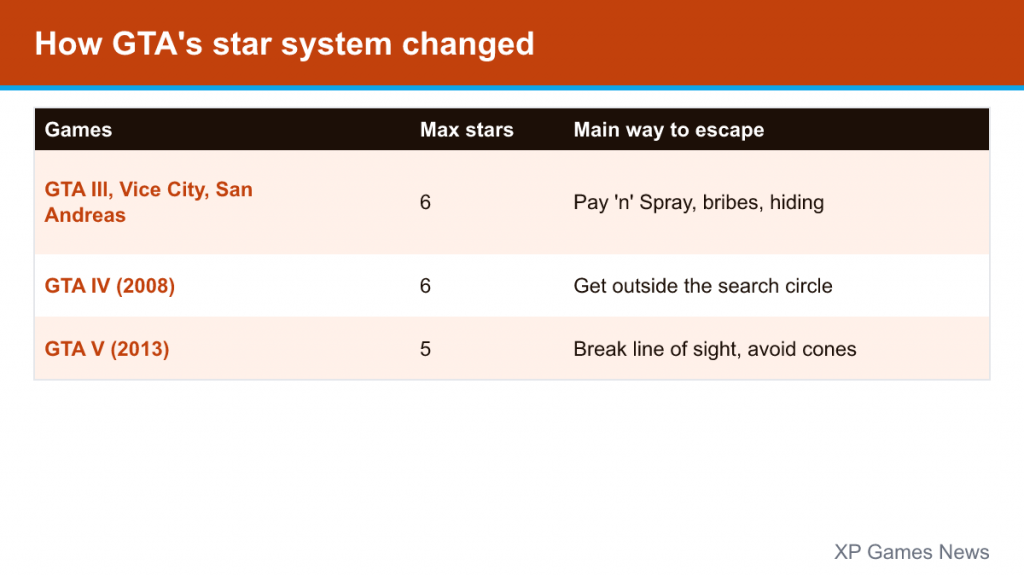
In GTA III, Vice City and San Andreas, the wanted meter went up to six stars. Low levels brought ordinary patrol cars and officers on foot; higher levels added roadblocks, SWAT teams, FBI agents and eventually the military, with tanks and helicopters at the top of the scale. Escape tools included Pay ‘n’ Spray garages, where a new paint job wiped your wanted level, and police bribe pickups hidden around the map that each removed a star. Surviving long enough out of sight at low levels would also let stars fade.
GTA IV: the search circle
GTA IV (2008) introduced a clearer escape model. When you were wanted, a circle appeared on the minimap showing the area police were searching. Getting outside that circle and staying away from officers allowed the wanted level to clear. Higher star levels meant a larger search radius, and the scale still topped out at six stars; GTA V later trimmed it to five.
GTA V: line of sight and vision cones
GTA V (2013) refined the approach around line of sight. While police can see you, your stars stay solid. Break their line of sight and the stars begin to flash, which means the police are now searching rather than chasing you directly. On the minimap, nearby officers show cones indicating their field of view. Stay out of those cones long enough and the wanted level disappears; get spotted and the chase resumes. Respraying your car at a Los Santos Customs garage while police are not watching also clears the level.
This made escapes feel more like stealth: hiding in an alley, under a bridge or in a tunnel became as useful as raw speed. Our GTA order guide covers where each of these games fits in the series if you want to compare them directly.
Red Dead Redemption 2: witnesses and bounties
Red Dead Redemption 2 (2018) uses a more grounded system built around witnesses, identification and bounties. It is one of the most detailed law systems in the genre.
Witnesses
Crimes are generally reported only if someone sees them. If a witness runs to report you, you can stop them by catching up and intimidating them (or by more violent means, which tends to make things worse). A passer-by who stumbles across the aftermath of a crime can also alert the law. When lawmen respond, a red search area appears on the map, and you need to leave it and stay hidden to lose your wanted status.
Identification and bounties
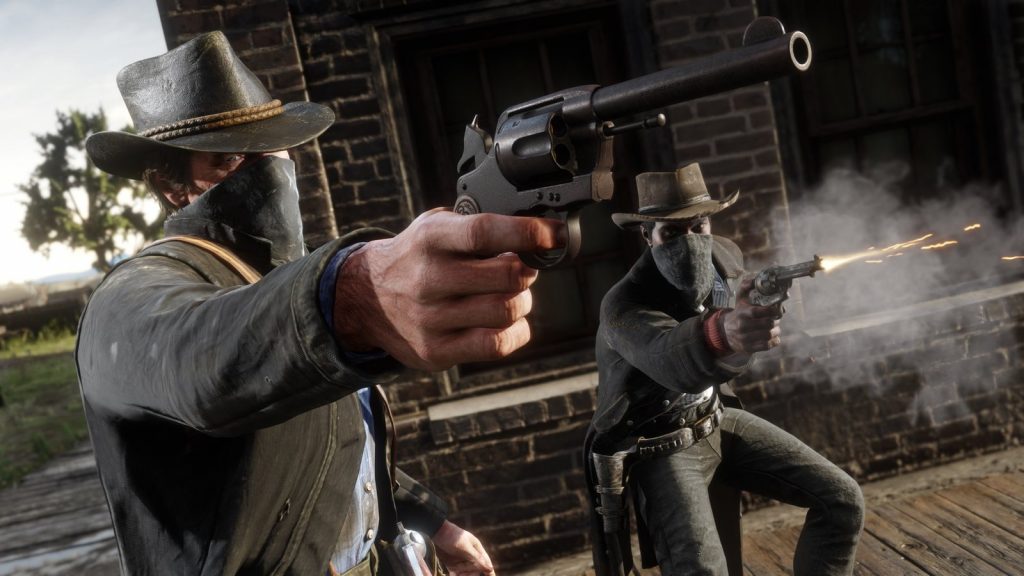
The game distinguishes between being an unknown suspect and an identified one. If you commit a crime while recognizable, the law can identify you, and a bounty is placed on your head in that state. Wearing a bandana mask makes identification harder, though it can draw suspicion in town. Once you have a bounty, you may find wanted posters, lawmen will be more alert to you in that region, and bounty hunters can come after you even after your wanted status has cleared.
Paying off
Bounties are paid at post offices, which are found in most towns. As long as you have the money, paying the clerk clears the bounty for that state. Bounties are tracked per state and grow as you commit more crimes there, so paying them off regularly makes travel through that territory much less eventful.
Red Dead 2’s system also interacts with its Honor system: some crimes lower Honor in addition to triggering a law response. If you are new to the series, our guide on where to start with Red Dead explains how the two main games relate.
Assassin’s Creed: notoriety and mercenaries
Assassin’s Creed’s law systems are tied to its emphasis on social stealth — blending into crowds to avoid notice.
Notoriety in the classic games
Assassin’s Creed II (2009) introduced a notoriety meter. Committing crimes, fighting guards or performing assassinations in public raised it. As it grew, guards became suspicious of you more quickly, until you were fully notorious and attacked on sight. Lowering notoriety meant tearing down wanted posters, bribing town heralds to stop spreading news about you, or eliminating corrupt officials. The system rewarded careful play and gave cities a sense of memory.
Mercenaries in Odyssey
Assassin’s Creed Odyssey (2018) replaced that model with a bounty system. Crimes such as theft and killing civilians raised a bounty level, and bounty hunters known as mercenaries would track you. Higher bounties sent more, and tougher, mercenaries. You could clear a bounty by paying it off, or by finding and killing the person who placed it. The mercenaries themselves became a kind of emergent rival system, each with their own traits and strengths.
Later entries have used their own variations, generally keeping the idea that hostile responses escalate with your behavior while giving you ways to reduce your profile.
Watch Dogs: calls, scanners and heat
Watch Dogs builds its police system around surveillance, which fits its premise of a city run by a networked operating system called ctOS.
Watch Dogs (2014)
In the first game, civilians who witness a crime may call the police. You can see these calls and interrupt them by hacking or jamming communications before the report goes through. Once police are pursuing you, a search area appears on the map, and the game encourages you to use the city itself to escape: raising bridges, changing traffic lights to cause collisions, triggering steam pipes or raising road blockers. Breaking line of sight and leaving the search area ends the chase. A reputation system tracked whether your actions made you look like a vigilante or a criminal, which affected how civilians reacted to you.
Watch Dogs 2 (2016)
The sequel tracked heat separately for different factions, including the police and the gangs of the San Francisco Bay Area. Police heat begins at low levels, where officers try to arrest you, and escalates toward lethal force as you keep committing crimes. Escaping clears the pursuit, and outstanding heat drops when you avoid further crimes. Watch Dogs 2 also let you use hacking aggressively — for example, calling the police or gangs on enemies to cause chaos.
Watch Dogs: Legion (2020)
Legion, set in London, uses a heat system as well, with the private security firm Albion acting as the main enforcement force. Its play-as-anyone design adds a twist: because you can recruit many different operatives, the person you are playing matters, and some characters can blend into enemy areas more easily than others.
Common escape principles across games
Although each system has its own rules, the same general tactics work in most of them:
- Break line of sight first. Tunnels, alleys, interiors and dense terrain are more useful than outrunning pursuers in a straight line.
- Leave the search zone. Many games show the area police are searching. Your goal is to get outside it and stay out of sight until the search ends.
- Change your profile. A new car paint job, a mask, a disguise or simply not wearing a weapon can lower attention depending on the game.
- Don’t add new crimes. Escalation is usually tied to continued offenses; fighting your way out often raises the response.
- Settle the debt. Games with bounties — Red Dead 2 and Odyssey, for instance — let you pay to clear your record. That is often cheaper than dealing with endless bounty hunters.
Why these systems matter for the genre
Law systems give the open world a memory. Without them, a sandbox has no friction, and the player’s actions lose weight. With them, the world pushes back, creating spontaneous chases and stand-offs that nobody scripted. The same crime in two different games can play out very differently because of how each system handles detection and escalation: GTA turns it into a high-speed action sequence, Red Dead 2 into a question of identity and reputation, Assassin’s Creed into social stealth, and Watch Dogs into a puzzle solved with the city’s own infrastructure.
The best systems are readable — you can see why the police found you and what you need to do to escape — and proportional, so that minor crimes don’t spiral into an all-out war unless you keep pushing. That balance between freedom and consequence is a big part of what makes open-world action games feel alive.