Dishonored Series Guide: Chaos System, Powers and Play Order
Everything you need to know about Dishonored: the games and DLC in order, how high and low chaos work, Blink and the other powers, and non-lethal play.
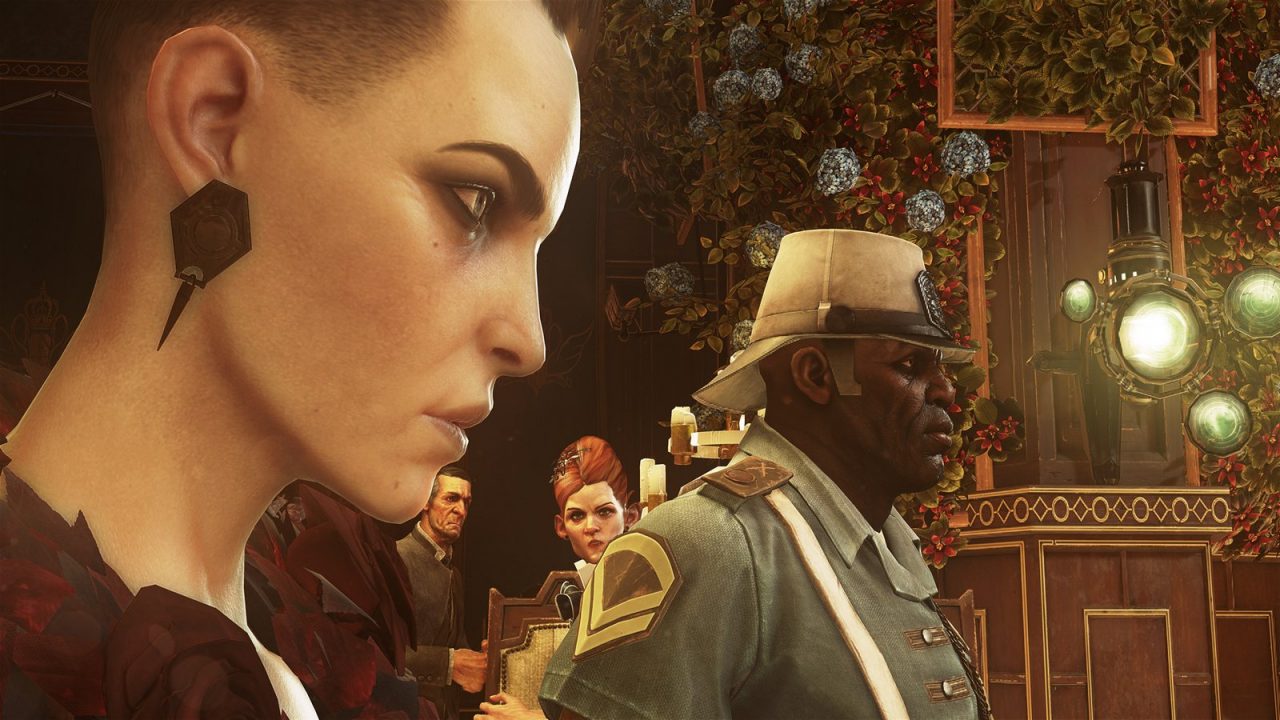
Dishonored is a series of first-person stealth-action games from Arkane Studios, set in a whale-oil-powered world inspired by industrial-era Britain and Europe. It belongs to the immersive sim tradition: levels are dense, interconnected spaces with many routes and solutions, and supernatural powers can be combined with ordinary tools in ways the designers did not explicitly script. Its signature system, chaos, quietly measures how violent you are and changes the world and ending in response.
This guide explains the games and expansions in order, how chaos actually works, the powers that define each protagonist, and how to approach a non-lethal playthrough. Story details are kept to premises.
The Dishonored games and DLC in order
Every game in the series was developed by Arkane Studios and published by Bethesda Softworks. The original game was a collaboration between Arkane’s Lyon and Austin offices; the later entries were led by Arkane Lyon.
| Title | Release | Protagonist | Type |
|---|---|---|---|
| Dishonored | October 9, 2012 | Corvo Attano | Main game |
| Dunwall City Trials | December 11, 2012 | — | Challenge-map DLC |
| The Knife of Dunwall | April 16, 2013 | Daud | Story DLC |
| The Brigmore Witches | August 13, 2013 | Daud | Story DLC (continues Knife of Dunwall) |
| Dishonored 2 | November 11, 2016 | Emily Kaldwin or Corvo Attano | Main game |
| Dishonored: Death of the Outsider | September 2017 | Billie Lurk | Standalone game |
A Game of the Year Edition with all the first game’s DLC appeared in 2013, and the Definitive Edition — the same bundle with improved visuals for PlayStation 4 and Xbox One — followed in August 2015. Arkane’s later game Deathloop (2021) is set in the same universe, far in the future, but it is a separate story and not required for following Dishonored.
The setting and premise
The first game takes place in Dunwall, capital of the Empire of the Isles, a city ravaged by a rat-borne plague. You play Corvo Attano, the Royal Protector, who is framed for the assassination of Empress Jessamine Kaldwin and the kidnapping of her daughter, Emily. Freed from prison by a group of loyalists, Corvo sets out to eliminate the conspirators who seized power and to rescue Emily.
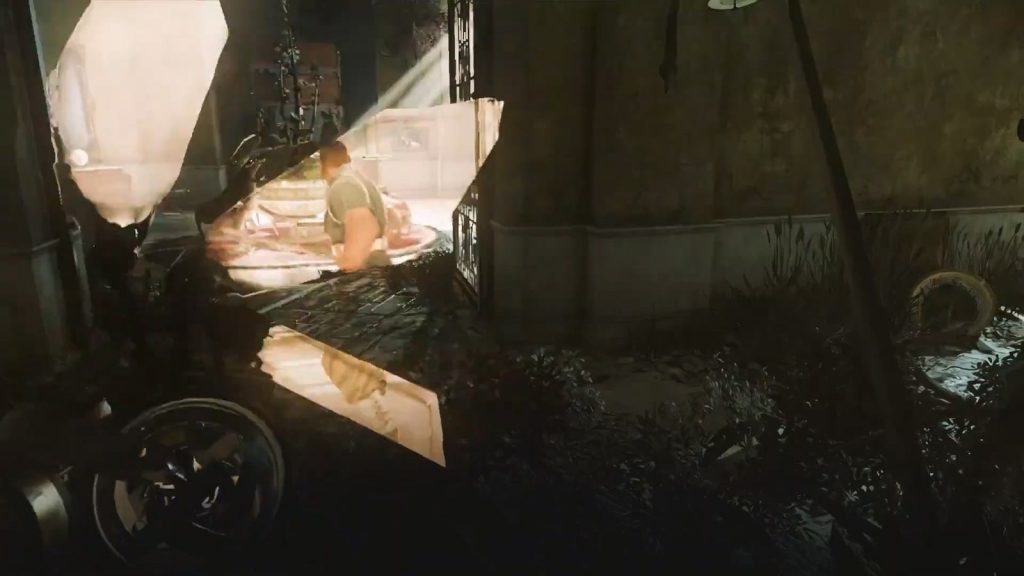
Early on, Corvo receives the Mark of the Outsider, a mysterious entity who grants supernatural abilities to people he finds interesting. The Outsider is neither good nor evil; he watches what you do with his gifts, and his commentary shifts depending on your choices.
Dishonored 2, set 15 years later, moves to Karnaca, a sun-baked coastal city in the south of the Empire. A coup led by Delilah Copperspoon removes Emily from her throne, and you choose to play either Emily or Corvo for the whole campaign. Death of the Outsider follows Billie Lurk, a former assassin from Daud’s gang, on a mission tied to the Outsider himself.
How the chaos system works
Chaos is the system that ties Dishonored’s gameplay to its story. Rather than labeling choices “good” or “evil,” the game tracks how much violence and death you cause and translates that into the state of the world.
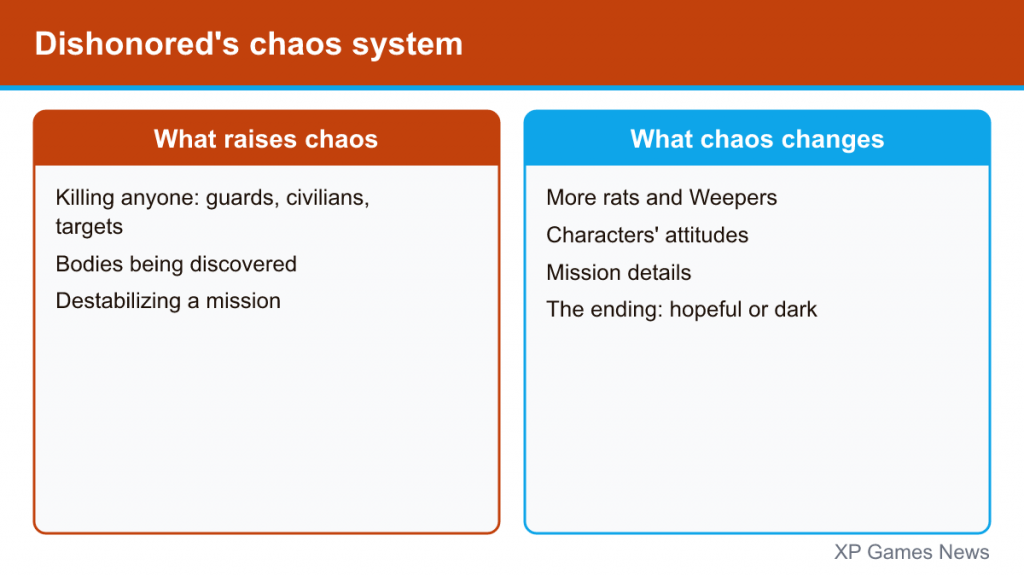
What raises chaos
- Killing people — guards, civilians and targets alike. Violence is the main driver.
- Bodies being discovered, which spreads alarm.
- Generally destabilizing actions in a mission, rather than any single isolated choice.
Chaos is evaluated mission by mission, and the overall trend determines whether your playthrough is considered high or low chaos. A few kills in an otherwise careful run do not automatically push you into high chaos; consistently violent play does.
What chaos changes
- The world. In the first game, high chaos leads to more rats and more plague victims (called Weepers) in later missions, making the city more dangerous.
- People’s behavior. Dialogue and the attitudes of characters around you change, and some allies behave differently depending on how you have acted.
- Scenes and level details. Certain missions add or change elements based on your chaos level.
- The ending. Low chaos leads to a more hopeful conclusion for Dunwall and the Empire; high chaos leads to a much darker one.
The design is intentionally a nudge rather than a punishment. Arkane built Dishonored’s combat to be enjoyable, but the chaos system means violence has a cost to the world you are trying to save. That tension is one reason the series is so often discussed in conversations about stealth design, as covered in our overview of stealth subgenres.
Chaos in later games
Dishonored 2 keeps the chaos system with a similar structure: violence raises chaos, and the endings and many details of Karnaca change accordingly. Death of the Outsider drops chaos entirely. Billie Lurk is a professional killer, and the game lets you play as violently or carefully as you like without the world judging you for it, though optional contracts and challenges still reward specific approaches.
Powers: Blink and the rest of the toolkit
Supernatural powers are bought and upgraded using runes, which you find hidden throughout levels. Bone charms add smaller passive perks.
Corvo’s powers (Dishonored)
- Blink — short-range teleportation. It is the series’ defining ability: you can blink onto ledges, across gaps and behind enemies, and the first game gives it to you at the start of the story.
- Dark Vision — see enemies, their vision cones and sound through walls.
- Possession — inhabit animals such as rats or fish, and at higher levels humans, to slip past guards.
- Bend Time — slow or stop time.
- Devouring Swarm — summon a pack of rats.
- Windblast — a burst of force that knocks enemies back.
Passive enhancements include improved agility and vitality, and Shadow Kill, which turns the bodies of slain enemies to ash so they cannot be discovered.
Emily’s powers (Dishonored 2)
Emily has her own set, distinct from Corvo’s: Far Reach (pulling yourself toward a point, or pulling objects and enemies toward you), Domino (linking several enemies so that what happens to one happens to all), Doppelganger (creating a decoy), Mesmerize (entrancing enemies) and Shadow Walk (moving as a creeping shadow). Corvo returns with an updated version of his original set. Dishonored 2 also lets you refuse the Outsider’s Mark at the start and play the whole game without supernatural powers — a significant challenge.
Billie’s powers (Death of the Outsider)
Billie has a smaller set: Displace (a teleport to a placed marker), Foresight (a scouting projection that freezes time) and Semblance (taking a person’s face as a disguise). Her abilities recharge over time rather than consuming mana potions.
Non-lethal play and the art of the target
One of Dishonored’s best ideas is that every major target in the main games can be dealt with without killing them. These non-lethal eliminations are not easier — they usually require exploring the level, finding a side character, or completing a favor — but they are often more interesting than a simple assassination.
The basic tools for non-lethal play include sleep darts, chokeholds from behind, and simply avoiding detection altogether. Unconscious bodies need to be hidden in safe places; leaving them in water or where rats can reach them can cause deaths that count against you.
The series also offers optional tracking for players who want to master stealth. The games recognize playthroughs where no one is killed and runs where no one ever spots you, through end-of-mission statistics and achievements. Players chasing those goals tend to plan methodically: scouting with Dark Vision, mapping guard routes, and using Blink to move along rooftops and ledges away from patrols. If you enjoy that kind of methodical planning, the readable guard behavior described in our enemy detection explainer applies directly to Dishonored.
The DLC: Daud’s story
The Knife of Dunwall and The Brigmore Witches tell one two-part story. You play Daud, the leader of the Whalers — the assassins responsible for the Empress’s death at the start of the main game. Haunted by what he has done, Daud seeks a kind of redemption, and his investigation leads him to the witch Delilah, who has plans of her own.
Daud has his own version of Blink that freezes time while you aim it, can summon fellow assassins, and has a different set of tools. Many players rate these expansions among the best content in the series. They also set up elements of Dishonored 2’s story, so it is worth playing them before the sequel. The fate of Daud himself is decided in the main game, where Corvo can choose to spare or kill him when they meet.
Recommended play order
- Dishonored
- The Knife of Dunwall
- The Brigmore Witches
- Dishonored 2
- Death of the Outsider
The simplest way to get the first three is a bundle that includes all the original DLC, such as the Definitive Edition. Dunwall City Trials is a set of challenge maps and can be ignored if you only care about the story.
For Dishonored 2, choose your protagonist based on preference: Emily offers new powers and a fresh perspective, while Corvo plays more like the first game. Many players do one of each on separate playthroughs, often one high chaos and one low chaos.
Tips for first-time players
- Explore before acting. Levels hide runes, bone charms, alternative routes and side characters that open new solutions.
- Prioritize Blink and Dark Vision. They are the backbone of stealth play and are useful in every style.
- Read notes and listen in. Conversations often reveal safe combinations, hidden passages and non-lethal options.
- Don’t fear combat on your first run. If you are not chasing a perfect stealth run, mixing approaches is part of the fun — and seeing a high chaos ending is a valid way to experience the story.
- Quicksave sensibly. Saves are generous, but stealth players should save before entering a new area and after major successes.
Players who enjoy Dishonored’s open-ended targets often also like the sandbox structure of our Hitman: World of Assassination guide, where every level is likewise a puzzle with many possible solutions.