Marvel’s Spider-Man Games in Order: Insomniac’s Series Explained
Insomniac's Spider-Man games in order: the 2018 game and DLC, Remastered, Miles Morales and Spider-Man 2, plus how Peter and Miles share the role.

Insomniac Games’ Marvel’s Spider-Man series is one of the most popular open-world action-adventures of recent years. Starting in 2018, it has told the story of an experienced Peter Parker and a newly empowered Miles Morales protecting a lively version of New York City. The games are built around traversal — web-swinging that feels fast, fluid and physical — and a combat system that mixes acrobatics with gadgets.
The release history can be slightly confusing because of DLC, a remaster, and a standalone game that launched at the same time as that remaster. This guide lists the games in release and story order, explains what each one adds, and covers how Peter and Miles share the mantle. Spoilers are limited to premises and early setups.
The games in release order
| Game | Original release | PC release | Lead character |
|---|---|---|---|
| Marvel’s Spider-Man | September 7, 2018 (PS4) | August 2022 (as Remastered) | Peter Parker |
| The City That Never Sleeps (DLC) | October–December 2018 (three episodes) | Included with Remastered | Peter Parker |
| Marvel’s Spider-Man: Miles Morales | November 2020 (PS4/PS5) | November 2022 | Miles Morales |
| Marvel’s Spider-Man Remastered | November 2020 (PS5) | August 2022 | Peter Parker |
| Marvel’s Spider-Man 2 | October 2023 (PS5) | January 2025 | Peter Parker and Miles Morales |
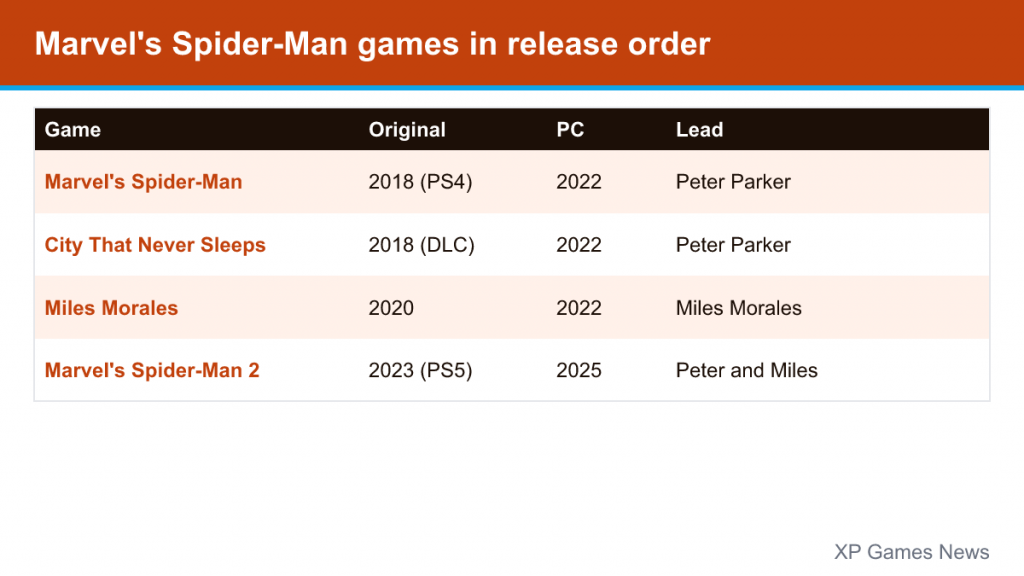
Remastered is an updated version of the 2018 game, not a new story. It launched alongside the PlayStation 5 in November 2020 bundled with the Ultimate Edition of Miles Morales, was later sold separately on PlayStation, and was the version released on PC in 2022. It includes all three City That Never Sleeps episodes.
Story order
For these games, release order and story order are essentially the same:
- Marvel’s Spider-Man (or Remastered)
- The City That Never Sleeps — set a few months after the main game
- Marvel’s Spider-Man: Miles Morales
- Marvel’s Spider-Man 2
The only real decision is whether to play the DLC before Miles Morales. It is not essential to the main arc, but it develops supporting characters and adds more activities in the same map, so it is best played straight after the base game if you have it.
Marvel’s Spider-Man (2018): Peter’s story
The first game introduces a Peter Parker who has been Spider-Man for about eight years. He is no longer a teenager learning his powers; he is in his twenties, working as an assistant to scientist Otto Octavius, struggling with rent, and trying to repair his relationship with Mary Jane Watson, now an investigative reporter.
The story opens with Spider-Man helping police take down Wilson Fisk, the Kingpin. Fisk’s arrest creates a power vacuum that a new gang, the Inner Demons, rushes to fill, led by a mysterious figure called Mister Negative. As the story escalates, more classic villains enter the picture.
What defines the gameplay
- Web-swinging. Webs attach to real buildings rather than the sky, and momentum carries through swings, wall runs and point launches. Traversal is the main pleasure of the game and the reason players often avoid fast travel.
- Combat. A fluid system of dodges, air combos and gadgets such as web bombs, impact webs and trip mines. Building focus lets you heal or perform finishers.
- Stealth sections. Spider-Man can perch above enemies and take them out one by one. There are also short sections where you play as Mary Jane or a young Miles, avoiding enemies without powers.
- Suits and upgrades. Dozens of unlockable suits, many with their own powers, alongside skill trees and gadget upgrades.
- Open-world activities. Crimes, bases to clear, collectibles such as Peter’s old backpacks, and research stations.
The map is revealed by repairing Oscorp surveillance towers in each district — a classic approach discussed in our article on open-world map design. Once revealed, Manhattan is packed with activities, but the city itself, with its landmarks and recognizable districts, is the star.
The City That Never Sleeps DLC
The 2018 game received a three-part story expansion, released monthly between October and December 2018:
- The Heist — Black Cat returns to New York, drawing Spider-Man into a gang conflict.
- Turf Wars — Hammerhead’s gang turns violent, putting police captain Yuri Watanabe at the center of the story.
- Silver Lining — mercenary leader Silver Sable becomes an uneasy ally as the Hammerhead conflict reaches its conclusion.
Each episode adds new suits, challenges and activities. Together they form a mini-arc that continues the main game’s themes of crime and power in the city.
Marvel’s Spider-Man: Miles Morales (2020)
Miles Morales is a shorter standalone game. Set about a year after the original, it follows Miles, who gained spider powers during the first game’s story and has been training with Peter. When Peter leaves New York for a trip abroad, Miles becomes the city’s only Spider-Man during a snowy holiday season in Harlem, his new neighborhood.
Miles has his own abilities that change the feel of combat and stealth:
- Venom powers. Bio-electric attacks (named “Venom” in the comics, unrelated to the symbiote) that hit harder and can chain between enemies.
- Camouflage. The ability to turn invisible for a short time, making stealth more flexible.
- A personal story. Miles’s relationship with his mother, his friends and his neighborhood gives the game a more intimate tone than the first.
Miles Morales is usually completed much faster than the 2018 game, which makes it a good bridge between the two larger entries. Its story leads directly into Spider-Man 2.
Marvel’s Spider-Man 2 (2023): two Spider-Men
Spider-Man 2 is the series’ biggest entry. Both Peter and Miles are playable, and you switch between them in the open world at almost any time, with certain story missions assigned to one or the other. Each character has his own abilities: Peter gains new symbiote powers as the story progresses, while Miles builds on his bio-electric attacks.
What’s new
- A bigger map. Brooklyn and Queens join Manhattan, roughly doubling the city.
- Web Wings. A gliding ability that makes crossing the larger map much faster and opens new traversal routes.
- New villains. The story features Kraven the Hunter and his hunt for powerful opponents, and the arrival of the Venom symbiote.
- More playable characters. Mary Jane has expanded sections with her own gadgets.
- Character switching. Many side activities belong to Peter or Miles, giving each his own neighborhood stories.
Spider-Man 2 makes the series’ central theme explicit: two people sharing one identity and one city, each with his own responsibilities and pressures.
How Peter and Miles share the role
The series handles the “two Spider-Men” idea carefully. In the first game, Miles is a supporting character — a teenager whose life is changed by the events of the story. In the post-credits scenes he gains spider powers, and Peter becomes his mentor. Miles Morales shows him growing into the role during Peter’s absence. In Spider-Man 2, the two are partners, balancing their personal lives with crime-fighting and helping each other through crises.
In November 2023, Spider-Man 2’s writers said Miles would be considered the main Spider-Man in future entries. Anything beyond that — titles, villains, release windows — should be treated as speculation until Insomniac announces it officially.
Where should you start?
The clear recommendation is to start with Marvel’s Spider-Man (or Remastered) and play in order. The story builds across games, and Spider-Man 2’s emotional beats depend on your knowledge of the earlier ones. Some considerations:
- Play the DLC if you can. It is included in Remastered and adds hours of content in the same map.
- Don’t skip Miles Morales. It is short, but it is essential context for Miles’s role in Spider-Man 2.
- If you only play one, Spider-Man 2 has the most features and the biggest map, but its story works best with the first two games behind you.
For players coming from other open-world series, the Spider-Man games are among the most approachable in the genre: generous checkpoints, multiple difficulty levels, and extensive accessibility options. If you are new to the genre itself, our genre explainer describes how they compare with other open-world action games.
Quick answers to common questions
Is Remastered different from the 2018 original?
The story, missions and map are the same. Remastered upgrades the visuals and performance for newer hardware, and it gave Peter Parker a new face model, which some returning players notice immediately. It also bundles the DLC, so it is the most complete way to play the first game today.
Do I need the first game to understand Miles Morales?
Technically no — Miles Morales opens with a short recap — but much of its emotional weight comes from relationships set up in the 2018 game, including Miles’s family history and his bond with Peter.
Are these games connected to the Spider-Man films?
No. Insomniac’s games tell their own original story in their own continuity, drawing on decades of comics rather than following any movie timeline.
Why traversal makes the series work
Many open worlds suffer from the “getting there” problem: long stretches between activities that become tedious. Insomniac’s games largely avoid it because movement itself is the reward. Swinging between skyscrapers, diving toward the streets and pulling up at the last moment is fun on its own, so moving across the map never feels like filler. That idea goes back to Treyarch’s Spider-Man 2 (2004), which our open-world history mentions as an early example of traversal carrying an open world.

Combined with a city full of recognizable landmarks, strong character writing and short, varied side activities, that focus on movement explains why the series has become a reference point for open-world action games.