What Is a Stealth Game? The Genre and Its Subgenres Explained
Stealth games reward avoiding detection over brute force. Here is how the genre works, its core goals and fail states, and the main subgenres.
Most action games ask a simple question: can you beat the enemies in front of you? Stealth games ask a different one: can you get what you need without them ever knowing you were there? That shift in goal changes everything about how a game plays. Patience replaces reflexes, observation replaces firepower, and the most satisfying outcome is often a fight that never happened.
This guide explains what makes a game a stealth game, the goals and failure states that shape the genre, and the major subgenres, from tactical espionage to sandbox assassination.
The core idea: information as the main weapon
In a stealth game, the player usually has less raw power than the opposition. Guards are numerous, alarms bring reinforcements, and open combat is either dangerous or penalized. What the player has instead is information and initiative. You can watch patrol routes, listen to conversations, study the layout and choose when and where to act. The enemies, by contrast, are reactive. They follow routines until something unusual catches their attention.
That imbalance is the heart of the genre. A good stealth game makes enemies readable enough that you can plan around them, but dangerous enough that a mistake has consequences. Most stealth games give the player tools to see what enemies perceive: a light meter, a detection indicator, visible view cones or audio cues when a guard grows suspicious.
The three player goals: avoid, distract, eliminate
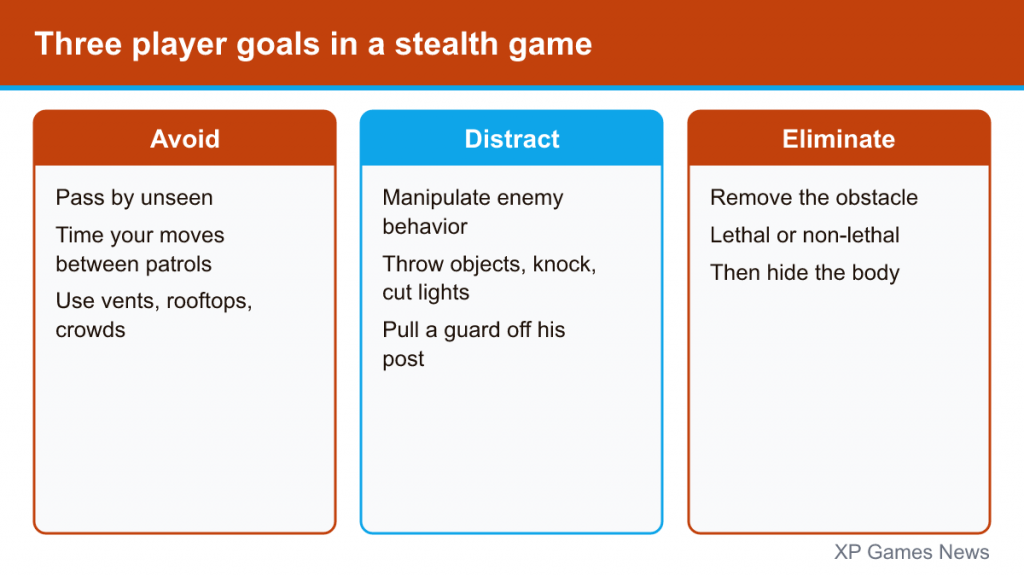
Almost every action in a stealth game falls into one of three categories.
Avoid
The purest form of stealth is passing by unseen. You time your movement between patrols, stay in shadows or cover, and take routes enemies do not watch: vents, rooftops, ledges, crowds. Some players make this a personal rule, a style usually called “ghosting,” in which no one is alerted, knocked out or killed.
Distract
When a path is blocked, you manipulate enemy behavior. Classic tools include throwing an object to make a noise, knocking on a wall, switching off a light or creating a tempting distraction. Metal Gear Solid’s knock on a wall and Thief’s noisemaker arrows are well-known examples. Distractions pull a guard away from a post, split a pair of patrollers, or turn a head long enough to slip past.
Eliminate
Sometimes the cleanest solution is to remove an obstacle, lethally or non-lethally. Takedowns, sleep darts, chokeholds and silenced weapons all serve this goal. Elimination introduces a new problem, though: bodies. An unconscious or dead guard who is found will usually raise an alarm, so many stealth games pair takedowns with the ability to carry and hide bodies.
The interplay of the three goals is what gives the genre depth. A good plan might involve distracting one guard, avoiding a camera, and eliminating a second guard in a spot where nobody will look.
Win and fail states
Stealth games differ a lot in how they treat failure, and the choice says a great deal about their design.
| Model | What happens when you are spotted | Examples |
|---|---|---|
| Instant fail | The mission ends or reloads at a checkpoint | Certain missions in early Splinter Cell games; many forced-stealth segments in non-stealth games |
| Escalation | Enemies enter an alert or combat phase, and you must escape, hide or fight | Metal Gear Solid series, Dishonored, Thief |
| Rating penalty | You can continue, but your end-of-mission rating drops | Hitman’s Silent Assassin rating |
| Consequences in the world | Your choices change the story or world state | Dishonored’s chaos system |
Modern games mostly favor escalation and ratings over instant failure. The reason is simple: instant failure punishes experimentation, and experimentation is much of the fun. Escalation lets a mistake turn into a tense escape, which is often more memorable than a perfect run.
The win condition is usually reaching an objective: an exit, a document, a target. But many games layer optional goals on top, such as completing a mission without being spotted, without killing anyone, or without raising an alarm. Those layers give the genre its famous replay value.
Subgenre 1: Tactical espionage
The tactical espionage action label comes directly from Metal Gear Solid’s own branding. The original Metal Gear released in 1987 on the MSX2 home computer, and Metal Gear Solid (1998) brought the formula into 3D on the PlayStation.
The defining traits are a military infiltration setting, a broad gadget toolkit, and a cinematic story. Enemies patrol bases, respond to noises and footprints, and call in reinforcements when they spot you. The series is also known for playful, layered systems: cardboard boxes, camouflage, codec conversations and enemies who react to unusual events in surprisingly specific ways.
Metal Gear Solid V: The Phantom Pain (2015) pushed the subgenre toward open-world design, giving players large regions full of outposts that could be approached from any direction.
Subgenre 2: Sandbox assassination
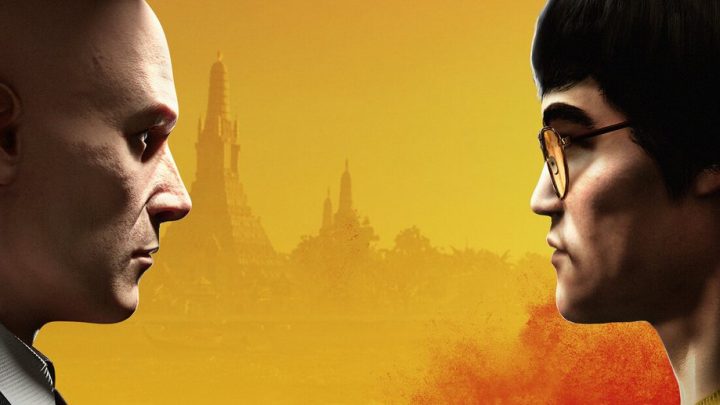
The Hitman series from IO Interactive, which began with Hitman: Codename 47 in 2000, defines this subgenre. Each level is a self-contained space, often a busy public location such as a fashion show, a mansion or a hotel, with one or more targets going about their routines.
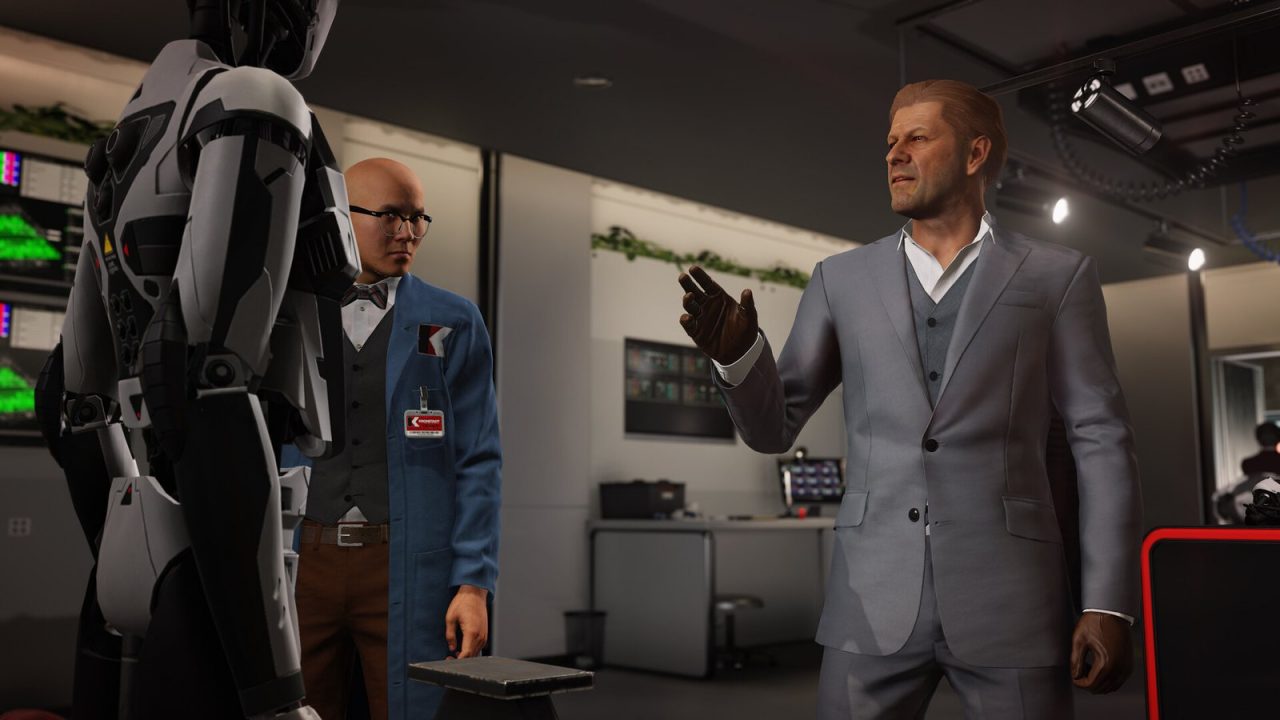
The player’s task is to eliminate the targets, but the means are almost entirely open. Disguises are central: wearing a waiter’s or guard’s uniform grants access to restricted areas. Levels are filled with opportunities to stage “accidents,” poison drinks or exploit a target’s habits. The trilogy that began with Hitman (2016) and is now bundled as Hitman: World of Assassination rewards replaying the same map many times to discover new methods.
What makes sandbox assassination distinct is its focus on a single goal surrounded by a dense web of possibilities. You are not just sneaking past people; you are engineering a situation.
Subgenre 3: Light and shadow
Some stealth games make darkness the primary resource. Thief: The Dark Project (1998), developed by Looking Glass Studios, is the classic example. Its “light gem” showed how visible the player was, and surfaces mattered: walking on tile made noise, while carpet and moss kept footsteps quiet. Water arrows could extinguish torches, creating new shadows.
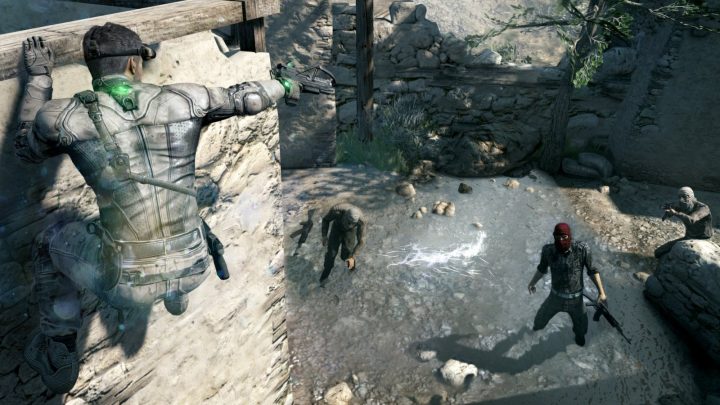
Tom Clancy’s Splinter Cell (2002) brought a similar emphasis to a modern espionage setting. Sam Fisher’s light meter, night vision goggles and the ability to shoot out lights made the environment itself a tool.
In this subgenre the map is less about routes and more about pools of light and dark, and the player’s main skill is reading and reshaping them.
Subgenre 4: Immersive sim stealth
Immersive sims are games built around systems that interact consistently, so a problem can be solved in many ways. Stealth is frequently the backbone of the genre, even though the player usually has the option to fight.
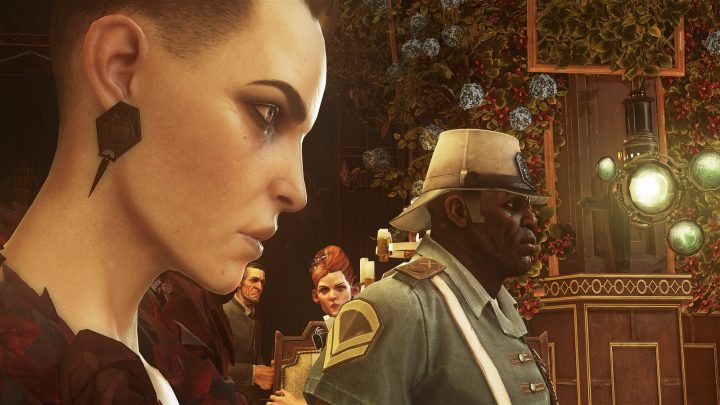
Arkane Studios’ Dishonored (2012) is a well-known modern example. Its protagonist, Corvo, has supernatural powers such as Blink, a short-range teleport, which give stealth a vertical, acrobatic quality. Levels offer multiple entry points and alternative routes, and the game’s chaos system tracks how violent the player is, shifting the world and the ending accordingly.
The immersive sim lineage traces back to Looking Glass’s work, including Thief, and continued through titles such as Deus Ex (2000). The common thread is freedom: the game does not tell you to be stealthy, but it makes stealth a rich and rewarding option.
Subgenre 5: Social stealth
Social stealth replaces shadows with crowds. Instead of hiding out of sight, you hide in plain sight by behaving like everyone else.
The original Assassin’s Creed (2007) built this idea into its identity. Players could blend into groups of monks, sit on benches or walk with crowds to avoid notice, while reckless running or climbing drew attention. Later games added mechanics such as hiring groups to provide cover and wanted posters that raised the character’s notoriety.
Hitman’s disguise system is social stealth as well. Wearing the right outfit lets you walk past people, but certain characters, often called enforcers by players, can see through specific disguises.
Hybrids and stealth in other genres
Many games outside the core genre include stealth as an option or as a mandatory segment. Open-world games such as Far Cry let you clear outposts quietly. Batman: Arkham Asylum (2009) built its “predator” rooms around stalking armed enemies from gargoyles and vents. Two-dimensional games such as Mark of the Ninja (2012) translated sound and sight cones into side-on visuals.
The distinction between a stealth game and a game with stealth comes down to emphasis. If stealth is the primary intended way to play, and the game’s systems are built to support it, it belongs to the genre. If stealth is one tool among many or limited to specific missions, it is a hybrid.
One area this guide deliberately leaves aside is horror-stealth, in which hiding from an unbeatable monster is used mainly to create fear. It shares mechanics with the genre but has its own design goals.
Why players love the genre
- Planning pays off. Watching a level, forming a plan and executing it flawlessly is deeply satisfying.
- Mistakes create stories. A plan going wrong often leads to the most memorable improvisation.
- Replay value. The same level can be played as a ghost, a pacifist or a ruthless assassin.
- Player expression. Two people can play the same mission in completely different ways.
Tips for newcomers
- Observe before acting. Spend time watching patrols. Most enemies follow predictable loops.
- Learn the detection signals. Each game tells you when you are close to being spotted. Understand those cues early.
- Use distractions generously. They are usually cheap or unlimited, and they solve many problems.
- Hide bodies. A found body is one of the most common causes of alarms.
- Do not fear failure. Most modern stealth games let you recover, and a messy run can still be fun.
Whether you prefer shadows, crowds or clever disguises, the stealth genre offers a style that rewards thinking first and acting second.