What Is an Open-World Action-Adventure Game? The Genre Explained
What makes a game an open-world action-adventure, how it differs from linear action games and open-world RPGs, and the classic series that define it.
“Open world” gets attached to almost every big release now, so the label has lost some of its meaning. Still, there is a recognizable family of games that share a set of habits: a large, continuous map you can roam at will, a story you can pick up or put down when you like, a heavy emphasis on moment-to-moment action rather than character statistics, and systems that interact with each other in ways the designers did not script line by line. That family is the open-world action-adventure, and it includes some of the best-selling series ever made: Grand Theft Auto, Red Dead Redemption, Assassin’s Creed, Far Cry and Marvel’s Spider-Man.
A working definition
An open-world action-adventure game is a game in which the player controls a single character (or a small cast) moving freely through a large, mostly seamless world, where progress comes primarily from the player’s own skill at combat, stealth, driving, climbing and other physical verbs, and where a main storyline sits alongside a large amount of optional content.
Each part of that definition does real work:
- Freely through a large world means you are not funneled down a corridor of levels. You choose where to go next, and the map is usually traversable without loading screens between areas.
- Player skill rather than character statistics is the line between action-adventure and role-playing. Your aim, timing and decisions matter more than the numbers attached to your character.
- A main storyline plus optional content describes the familiar structure of story missions marked on the map alongside side missions, activities, collectibles and random events.
None of these is absolute, but if a game hits all three, most players will recognize it as part of this family.
Sandbox freedom: what “open” really means
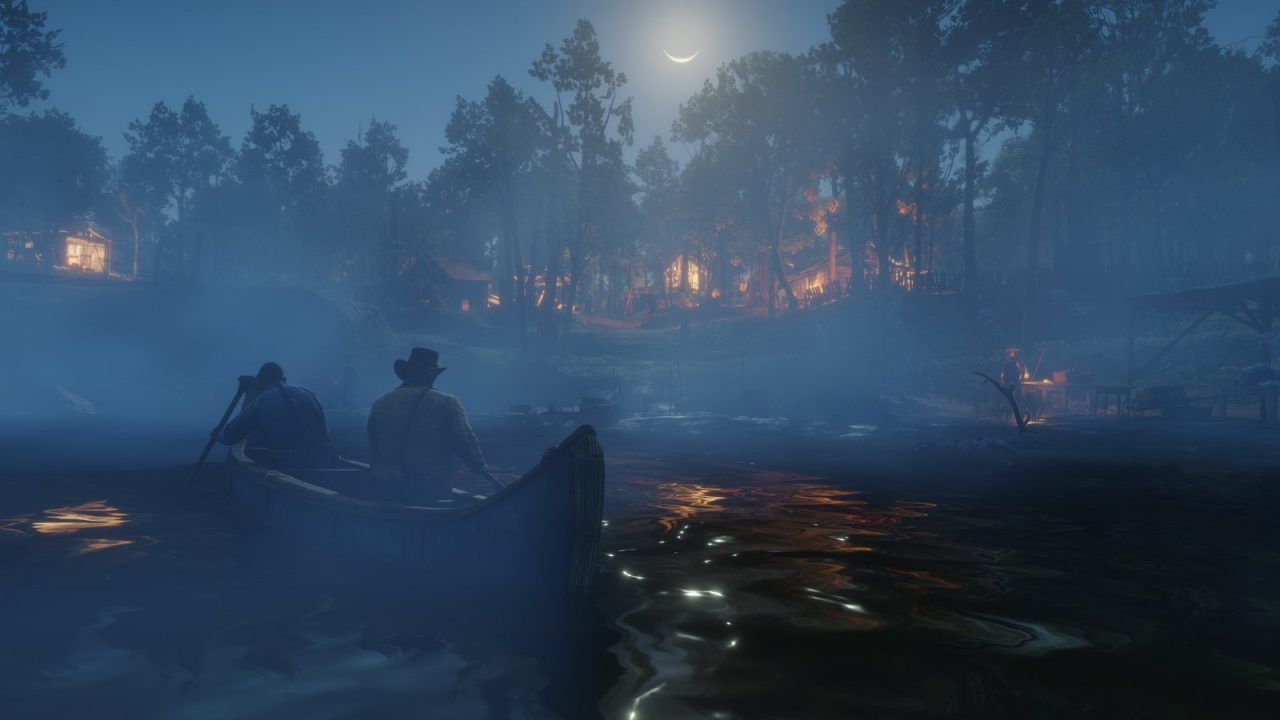
The defining pleasure of these games is choice. In Grand Theft Auto V (2013) you can ignore the next story mission for hours and spend the time driving around Los Santos, taking on side jobs, or simply causing trouble and seeing how the police respond. In Red Dead Redemption 2 (2018) you can ride off into the wilderness to hunt, fish or follow a stranger’s request, and the story waits for you.
Freedom shows up in three distinct layers:
- Freedom of route. You decide which part of the map to visit and in what order. Many games gate some areas behind story progress, but the bulk of the world is usually open early.
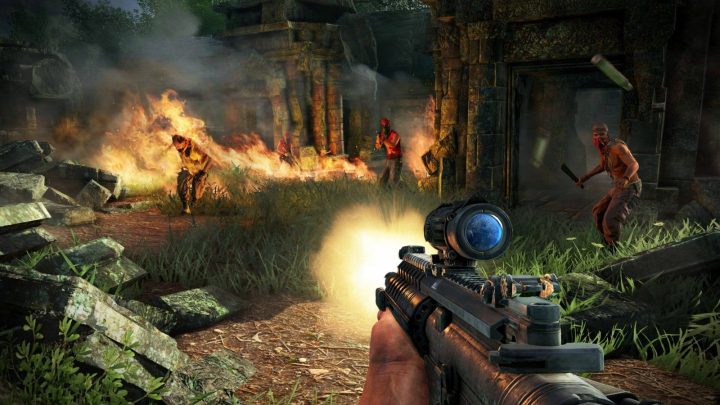
- Freedom of approach. Within a mission or an enemy camp, you can often choose how to tackle it. Far Cry’s outposts are a classic example: scout from a hill, tag enemies, then go in quietly with a bow or loudly with a rifle and a vehicle.
- Freedom of pace. You control how much time you spend on the story versus everything else. Some players race through the main missions; others clear every icon on the map.
The word “sandbox” is often used interchangeably with “open world,” but it points to something slightly different: a world full of tools and rules you can play with for their own sake. GTA’s vehicles, weapons and police response form a sandbox; so does a Far Cry firefight when fire spreads through dry grass.
Main content vs side content
Almost every game in the genre separates its content into a few layers. The names vary by series, but the structure is remarkably consistent.
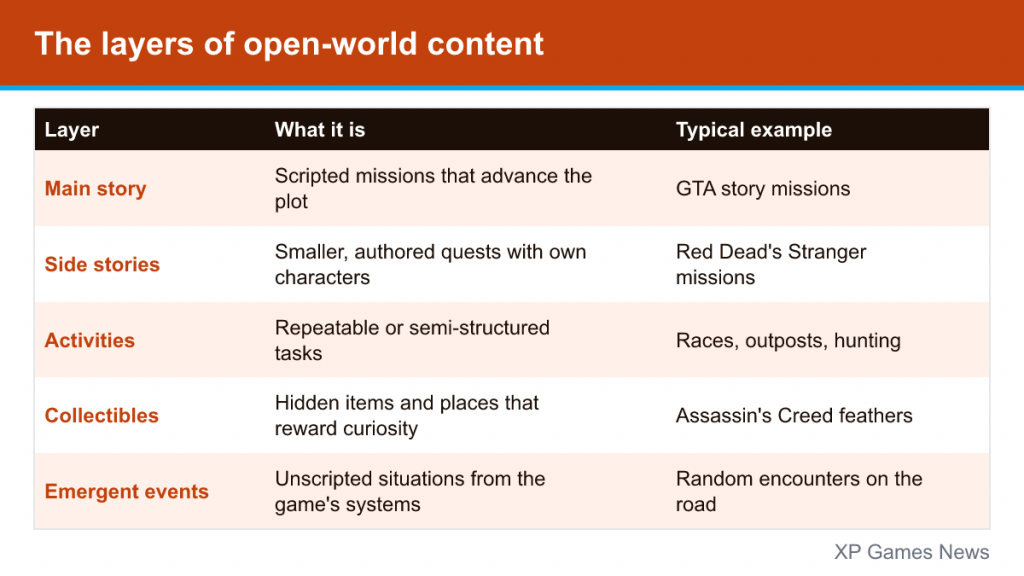
| Layer | What it is | Typical examples |
|---|---|---|
| Main story | Scripted missions that advance the plot and usually unlock new areas or tools | GTA story missions, Red Dead 2’s chapters, Assassin’s Creed memory sequences |
| Side stories | Smaller, authored quests with their own characters | Red Dead’s Stranger missions, Spider-Man’s side quests |
| Activities | Repeatable or semi-structured tasks | Races, outposts, hunting, crime-fighting encounters |
| Collectibles and exploration | Hidden items and locations rewarding curiosity | Assassin’s Creed feathers and chests, Spider-Man backpacks |
| Emergent events | Unscripted situations that arise from the game’s systems | Random encounters on Red Dead’s roads, a police chase that starts with a traffic accident |
A common criticism of the genre is that side content can become a checklist: a map crowded with icons, each representing a near-identical task. Developers have responded in different ways. Red Dead Redemption 2 leaned heavily on handcrafted encounters and environmental detail. Later Assassin’s Creed and Far Cry games experimented with options to reduce on-screen guidance. Marvel’s Spider-Man (2018) kept a fairly traditional icon structure but made moving between icons so enjoyable, thanks to web-swinging, that the travel itself became a reward.
Systemic play: when the rules write the story
The feature that most clearly separates an open-world action-adventure from a large linear game is systemic design. Instead of scripting every outcome, designers build rules for how characters, objects and the environment behave, then let them collide.
Some familiar systems:
- Law enforcement. GTA’s wanted level escalates the police response as you commit more serious crimes. Red Dead Redemption 2 tracks witnesses and bounties. These systems turn an ordinary drive into a chase without any scripted trigger.
- Wildlife and ecology. Far Cry’s animals attack enemies and players alike. A bear wandering into an enemy camp can change a fight entirely.
- Crowds and social stealth. Assassin’s Creed lets you blend into groups of civilians to avoid guards, a system that depends on crowds behaving predictably.
- Traversal physics. Climbing, swinging, gliding and driving each follow consistent rules, so players can invent their own routes.
The result is what players call emergent gameplay: memorable moments nobody wrote. A horse spooks during a shootout. A guard notices a body because a patrol route changed. A car you are chasing crashes into a bus. These moments are a big part of why people keep playing long after the credits.
How it differs from linear action games
A linear action game moves you through a planned sequence of spaces. Each level is tuned for a specific experience: an encounter here, a set piece there, a breather before the next fight. Think of a classic campaign shooter or a character-action game, where the designer controls pacing tightly.
Open worlds trade that control for freedom. The consequences go both ways:
- Pacing is looser. The story might tell you a friend is in danger while you spend an afternoon fishing. Critics call this tension between story urgency and player freedom a pacing or “ludonarrative” problem.
- Set pieces are often concentrated in story missions, which can feel more linear than the world around them. Many GTA and Red Dead missions are effectively linear levels placed inside the open map.
- Replayability tends to be higher, because systemic encounters play out differently each time.
Plenty of games sit between the two. Some titles use large hub areas connected by linear stretches, or wide levels that are open within their boundaries. Those are sometimes described as “semi-open.” The full open-world label usually implies one continuous map.
How it differs from open-world RPGs
This is the boundary people argue about most. Open-world role-playing games share the large map and the main-plus-side structure, but they put character progression at the center: statistics, skill trees, loot with numerical tiers, and dialogue choices that branch the story.
A practical test is to ask what determines success in a fight. In an action-adventure, it is mostly your aim, timing and tactics. In an RPG, the character’s level and equipment numbers carry much more weight; an under-leveled character may be unable to win no matter how well you play.
Some series have moved along this spectrum. Assassin’s Creed is the clearest case. The games from Assassin’s Creed (2007) through Syndicate (2015) were firmly action-adventures. Starting with Origins (2017), the series added experience levels, gear rarity and much larger maps, borrowing heavily from RPGs. Assassin’s Creed Mirage (2023) deliberately returned to a smaller, stealth-focused structure. Because of that history, Assassin’s Creed is often cited when people debate where one genre ends and the other begins.
For this site’s purposes, the focus stays on the action-adventure side: movement, stealth, combat, driving, story and world design rather than build optimization.
The series that define the genre
A handful of franchises are so closely associated with the genre that they are used as shorthand for it.

Grand Theft Auto
Rockstar’s crime series began with a top-down game in 1997, but Grand Theft Auto III (2001) is the entry most often credited with popularizing the modern 3D open-world city. Vice City (2002), San Andreas (2004), GTA IV (2008) and GTA V (2013) refined the formula of story missions, satirical radio and a police system wrapped around a living city. Grand Theft Auto VI was scheduled for November 19, 2026 on PlayStation 5 and Xbox Series X|S at the time of writing.
Red Dead Redemption
Rockstar’s western series applied the GTA template to the American frontier. Red Dead Redemption (2010) followed John Marston; Red Dead Redemption 2 (2018), a prequel, followed Arthur Morgan and became a reference point for detailed, slower-paced world simulation.
Assassin’s Creed
Ubisoft’s series, launched in 2007, built its identity on climbing historical cities, social stealth in crowds, and viewpoints that reveal the surrounding map. Its many settings run from ancient Greece to Victorian London and feudal Japan, the setting of Assassin’s Creed Shadows (2025).
Far Cry
The original Far Cry (2004) was developed by Crytek; Ubisoft took over the series afterwards. Far Cry 3 (2012) established the modern formula of capturable outposts, radio towers, hunting and crafting, and a memorable villain, which later entries built on.
Marvel’s Spider-Man
Insomniac Games’ Marvel’s Spider-Man (2018) showed how much a single traversal mechanic can carry an open world. Its web-swinging through Manhattan is fast, readable and fun on its own, and it was followed by Miles Morales (2020) and Marvel’s Spider-Man 2 (2023).
Other notable series include Watch Dogs, Just Cause, Mafia and Batman: Arkham.
Common misconceptions
“Bigger is better.” Map size is easy to market but does not guarantee quality. Many players rate dense, detailed worlds above larger, emptier ones. Assassin’s Creed Mirage was received partly as a response to fatigue with very large maps.
“Open world means no story.” Several of the genre’s most praised games are story-heavy. Red Dead Redemption 2 is frequently discussed for its narrative as much as its world.
“Any game with a big map is an RPG.” As covered above, the deciding factor is how progress and success are determined, not the size of the map.
“Side content is filler.” It can be, but well-designed side stories often contain a game’s most memorable characters and writing.
Where to start if you are new
If you want a sense of the genre without a huge time commitment, Marvel’s Spider-Man is a good entry point: its map is compact by modern standards, its controls are approachable, and the story moves briskly. Grand Theft Auto V is the classic crime sandbox and remains widely available. If you prefer a slower, more atmospheric experience and do not mind a long campaign, Red Dead Redemption 2 is the genre at its most detailed. For historical settings with stealth at the center, Assassin’s Creed Mirage or one of the classic-era Assassin’s Creed games offer a tighter version of the formula.
Whatever you choose, the best way to appreciate an open-world action-adventure is to step off the main path now and then. The story will wait, and the moments you find on your own are often the ones you remember.