Halo Campaigns in Order: The Master Chief Story From Combat Evolved to Infinite
Every main Halo campaign in release and story order, what The Master Chief Collection includes, where the spin-offs fit and how to approach the saga.

Halo is best known to many people for its multiplayer, but the series has always been built on its single-player campaigns: the story of the Master Chief, his AI companion Cortana, and humanity’s war against the alien alliance known as the Covenant. With eight main campaigns, a long-running compilation, a 2026 remake and several spin-offs, it is not always obvious where to begin. This guide covers the campaigns only, in release order and story order, and explains what The Master Chief Collection contains.
The main campaigns in release order
| Year | Game | Developer | Playable lead |
|---|---|---|---|
| 2001 | Halo: Combat Evolved | Bungie | Master Chief |
| 2004 | Halo 2 | Bungie | Master Chief and the Arbiter |
| 2007 | Halo 3 | Bungie | Master Chief (with the Arbiter in co-op) |
| 2009 | Halo 3: ODST | Bungie | The Rookie and his ODST squad |
| 2010 | Halo: Reach | Bungie | Noble Six |
| 2012 | Halo 4 | 343 Industries | Master Chief |
| 2015 | Halo 5: Guardians | 343 Industries | Spartan Locke and Master Chief |
| 2021 | Halo Infinite | 343 Industries | Master Chief |
Bungie created the series and made the first five games before moving on. Microsoft’s 343 Industries took over with Halo 4. In 2024 the studio was renamed Halo Studios, and its first major release under that name was Halo: Campaign Evolved, a remake of the first game released on July 28, 2026.
The campaigns in story order
Internally, the main story runs as follows. The years refer to the in-universe calendar.
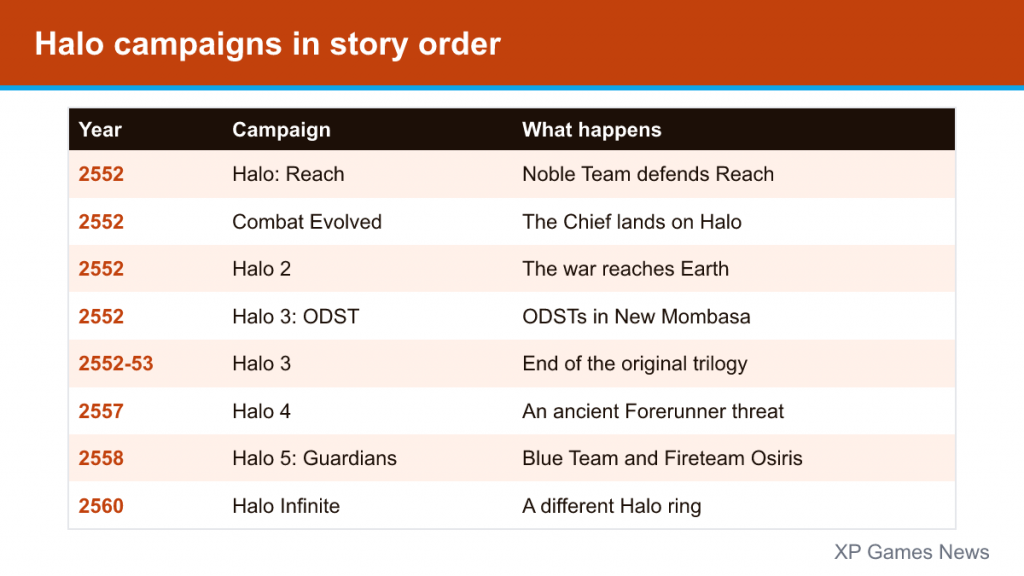
- Halo: Reach – 2552. A prequel about Noble Team’s doomed defense of the planet Reach. It ends just before the first game begins.
- Halo: Combat Evolved – 2552. The Master Chief and Cortana land on a ringworld called Halo and uncover its purpose.
- Halo 2 – 2552. The war reaches Earth, and the story splits between the Chief and the Arbiter, a disgraced Covenant commander.
- Halo 3: ODST – 2552. Set during the events of Halo 2, following a squad of Orbital Drop Shock Troopers in the city of New Mombasa.
- Halo 3 – 2552-2553. The conclusion of the original trilogy.
- Halo 4 – 2557. The Chief awakens years later and faces an ancient threat tied to the Forerunners, the precursor race who built the Halo rings.
- Halo 5: Guardians – 2558. A story split between the Chief’s Blue Team and Spartan Locke’s Fireteam Osiris.
- Halo Infinite – 2560. The Chief returns to a different Halo ring after a major defeat for humanity.
Halo: Campaign Evolved retells Combat Evolved and adds a three-mission prequel arc, Operation: METEORITE, set about a year before the original game and featuring the Chief alongside Sergeant Avery Johnson.
Release order vs story order: which to choose
For Halo, release order is generally the better choice, with one popular exception.
- Reach’s ending lands better after Combat Evolved. Reach was designed as a prequel for players who already knew the original trilogy. Its final moments connect directly to the first game, which is much more satisfying if you have played it.
- ODST fits naturally after Halo 2 or Halo 3. It is set during Halo 2, so playing it between Halo 2 and Halo 3 matches the story, but it also works after Halo 3 as originally released.
- Gameplay evolves over time. The jump from Halo 3 to Halo 4 introduced new enemies, weapons and abilities, and Halo 5 added Spartan movement such as clamber and thruster boosts. Going in order makes these additions feel like progress.
A common compromise is: Combat Evolved, Halo 2, Halo 3, ODST, Reach, Halo 4, Halo 5, Infinite. That is simply release order, and it is the most frequently recommended path.
Some fans prefer to start with Reach because it has the most modern feel of the Bungie games and sets up the first game’s opening. That works, but you will miss the emotional payoff that Reach provides to returning players.
What The Master Chief Collection includes
Halo: The Master Chief Collection is the easiest way to play the first six campaigns. It launched on Xbox One on November 11, 2014 and came to PC in stages between December 2019 and November 2020. It contains:
- Halo: Combat Evolved Anniversary, the 2011 remaster, which lets you switch between original and updated graphics at the press of a button.
- Halo 2 Anniversary, a remaster made for the collection with new graphics and remade cutscenes.
- Halo 3
- Halo 3: ODST, whose campaign was added in May 2015.
- Halo: Reach, added with the PC release in December 2019.
- Halo 4
An update in November 2020 enhanced the collection for Xbox Series X|S, including higher frame rates and resolutions. The collection also lets you play the campaigns in co-op and supports optional modifiers called skulls.
Halo 5: Guardians is not part of the collection and remains available on Xbox One, playable on Xbox Series X|S through backward compatibility; it was never released on PC. Halo Infinite is available on Xbox and PC.
Halo: Campaign Evolved
Released on July 28, 2026, Halo: Campaign Evolved is a remake of the first game’s campaign, built by Halo Studios in Unreal Engine 5. It is notable for several reasons:
- It is the first mainline Halo campaign released on PlayStation 5, alongside Xbox Series X|S and PC.
- It keeps the original ten missions and adds three new prequel missions.
- It supports online co-op for up to four players and two-player split-screen on consoles.
For newcomers who want a modern way into the story, Campaign Evolved is an appealing starting point. Players who already own The Master Chief Collection can still use Combat Evolved Anniversary, which preserves the original game’s feel and offers its own graphics toggle.
Where the spin-offs fit
Several Halo games sit outside the main campaign line but share its universe.
- Halo Wars (2009) is a real-time strategy game developed by Ensemble Studios. Set about two decades before the first game, it follows the crew of the ship Spirit of Fire.
- Halo Wars 2 (2017), developed by Creative Assembly and 343 Industries, continues the Spirit of Fire story and is set around the time of Halo 5.
- Halo: Spartan Assault (2013) and Halo: Spartan Strike (2015) are top-down twin-stick shooters originally released for Windows devices, with Spartan Assault later coming to Xbox. They tell smaller side stories.
None of these is required to understand the main campaigns. Halo Wars 2’s story does, however, introduce a faction and a character that play a role in Halo Infinite, so playing it or reading a summary can add context before Infinite.
The wider Halo universe also includes many novels, comics and animated projects. They expand the lore considerably, but the games are written so that you can follow them without the books.
What makes Halo’s campaigns stand out
Halo: Combat Evolved helped establish several design ideas that became common in console shooters:

- A two-weapon limit, encouraging players to make choices and pick up enemy weapons.
- Regenerating shields, which changed how fights were paced by rewarding players who briefly retreated.
- Dedicated grenade and melee buttons, making them part of the core combat loop.
- Vehicles in the campaign, such as the Warthog, allowing large open battles within missions.
- Enemy behavior with distinct roles: Grunts that panic, Elites that dodge and take cover, and Jackals with shields.
Many fans describe Halo’s design as “30 seconds of fun,” a phrase associated with Bungie’s approach of building a satisfying core combat loop and then placing it in varied situations. Missions mix tight interiors with wide outdoor battles, often letting players choose how to approach an encounter.
Halo Infinite moved the series toward a more open structure, placing the Chief on a large, explorable section of the Zeta Halo ring with outposts and side objectives, and introducing a grappling hook called the Grappleshot. It borrows ideas such as capturable bases and optional side content from the open-world action-adventure playbook, while keeping its main story missions as more traditional, linear Halo levels. Reactions to the change were mixed, but many players found that Halo’s combat sandbox, with its varied enemies and vehicles, suited a larger space surprisingly well.
Tips for playing the campaigns
- Choose difficulty thoughtfully. Normal is the intended introduction for many players. Heroic is often recommended for those comfortable with shooters, as it makes enemy behavior more noticeable without being punishing. Legendary is for experienced players and is very demanding.
- Play in co-op if you can. Co-op has been part of Halo since the first game, though support varies by entry and platform, and playing the story with a friend is a big part of the series’ appeal.
- Do not rush through the vehicle sections. Some of the best moments in the Bungie trilogy happen in open areas where you can choose between driving, flying and fighting on foot.
- Experiment with skulls. These optional modifiers change gameplay, from making enemies tougher to more playful effects.
- Read the terminals and logs. Several games hide extra story in collectibles and terminals, which add context for later entries.
Quick answers
Where should a newcomer start? With Halo: Combat Evolved, either through The Master Chief Collection or Campaign Evolved, and then in release order.
Do I need to play Halo 5 before Infinite? It helps, since Infinite picks up threads from Halo 5, but Infinite recaps its key context.
Is ODST about the Master Chief? No. It follows a separate squad of human soldiers, and it is a different, more atmospheric experience.