Half-Life Series Explained: Story, Games and Play Order
A clear guide to the Half-Life series: every main game and expansion, how the story fits together, who G-Man is, and the best order to play.
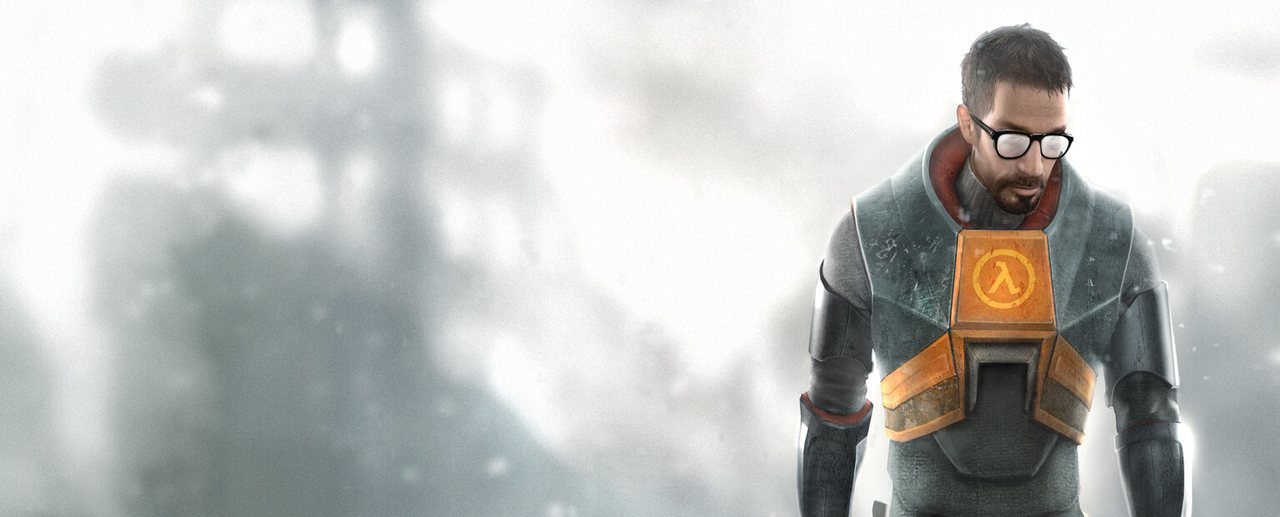
Few shooter series have had as much influence with as few releases as Half-Life. Valve’s science-fiction saga runs to two numbered games, two episodic follow-ups, a VR prequel and a handful of expansions made by another studio, yet it shaped how single-player shooters tell stories for more than two decades. If you are coming to it fresh, the structure can look confusing: expansions that retell the same disaster from other viewpoints, “episodes” that are really a third act, and a story that stops on a cliffhanger that has never been resolved in a numbered sequel.
This guide lays out every game, explains the core story elements — Black Mesa, the Combine, the G-Man — and suggests a play order depending on how much time you have. Plot details are kept to premises and widely known setups; the late-story section is flagged before it gets specific.
Every Half-Life game at a glance
The main line was developed by Valve. The three expansions to the first game were developed by Gearbox Software, with Valve publishing.
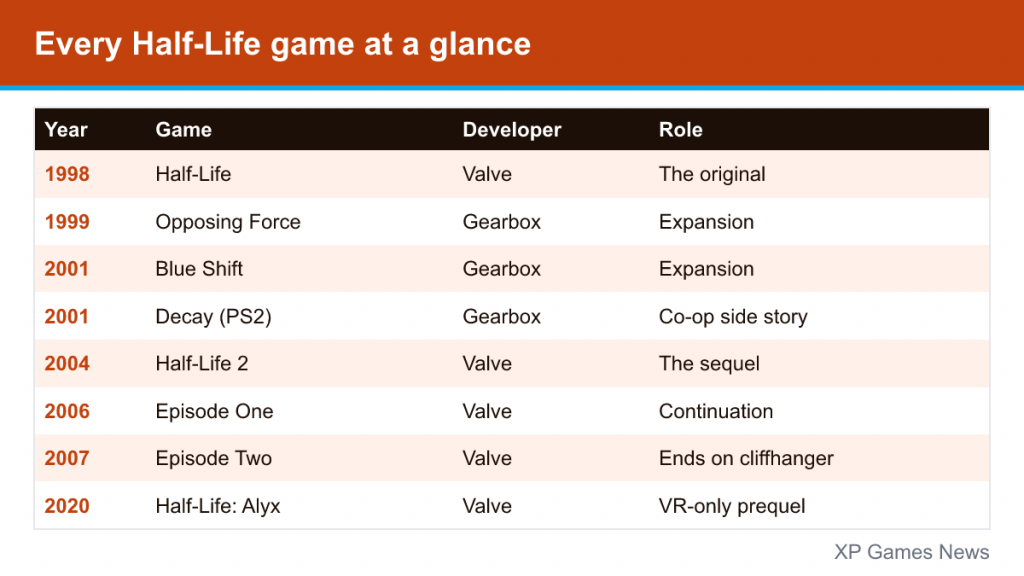
| Game | Release | Developer | Role in the series |
|---|---|---|---|
| Half-Life | November 1998 | Valve | The original: Gordon Freeman and the Black Mesa disaster |
| Half-Life: Opposing Force | November 1999 | Gearbox Software | Expansion: the same incident seen by soldier Adrian Shephard |
| Half-Life: Blue Shift | June 2001 (PC) | Gearbox Software | Expansion: security guard Barney Calhoun’s escape |
| Half-Life: Decay | November 2001 (PS2) | Gearbox Software | Co-op side story included with the PlayStation 2 port |
| Half-Life 2 | November 16, 2004 | Valve | The sequel: City 17 and the Combine occupation |
| Half-Life 2: Episode One | June 1, 2006 | Valve | Direct continuation of Half-Life 2’s ending |
| Half-Life 2: Episode Two | October 10, 2007 | Valve | Continuation into the countryside; ends on the series cliffhanger |
| Half-Life: Alyx | March 23, 2020 | Valve | VR-only game set between the first two numbered games |
Episode Two originally launched as part of The Orange Box, the 2007 bundle that also introduced Portal. Today the Steam page for Half-Life 2 lists Episode One and Episode Two as included with the base game, so buying Half-Life 2 on PC gets you the whole second-game arc in one package.
The setting: Black Mesa and the Resonance Cascade
The original Half-Life puts you in the hazard suit of Gordon Freeman, a theoretical physicist working at the Black Mesa Research Facility, a sprawling underground complex in the New Mexico desert. Freeman is a deliberately silent protagonist — he never speaks, and the game never cuts away from his eyes. That choice was a big part of the series’ identity: there are no traditional cutscenes, and story events happen around you while you keep control.
The disaster begins with a routine-seeming experiment on an anomalous crystal sample. It goes wrong and causes what the game calls a resonance cascade, tearing open rifts to a borderworld called Xen. Alien creatures begin pouring into the facility: headcrabs that latch onto scientists and turn them into zombies, electrically charged Vortigaunts, and larger beasts. Before long, the military arrives — not to rescue the staff but to contain the incident and silence witnesses, which means you are fighting both aliens and soldiers.
The structure was revolutionary for 1998. Instead of separate levels with score screens, Half-Life presents one continuous journey through the base, broken only by short loading pauses. The famous opening tram ride, which simply carries you through the facility while an announcer reads routine notices, became a template for “show, don’t tell” introductions. Scripted sequences — a scientist dragged into a vent, a security guard opening a door for you — make the world feel alive without stopping play.
The final chapters take Freeman to Xen itself, a low-gravity world of floating islands. Those levels, with their fiddly platforming, are the most divisive part of the original.
The expansions: three other views of the same day
Gearbox’s expansions are interesting because they do not continue the story. They retell the Black Mesa incident from other perspectives, crossing paths with Freeman’s journey at certain moments.
Opposing Force (1999)
You play Corporal Adrian Shephard, a Marine from the Hazardous Environment Combat Unit sent to clean up Black Mesa. His squad’s mission collapses quickly, and Shephard ends up fighting to survive. Opposing Force adds new weapons, new alien enemies (the Race X creatures) and squad-mate soldiers who can heal you or open doors. It is the meatiest of the three and the one most often recommended.
Blue Shift (2001)
Blue Shift follows Barney Calhoun, one of Black Mesa’s security guards. It is shorter and less combat-heavy, focusing on escaping with a group of scientists. The Barney name matters because a character called Barney Calhoun becomes a major ally in Half-Life 2, and Blue Shift helped fill in his background.
Decay (2001)
Decay was a two-player co-operative campaign packaged with the PlayStation 2 version of Half-Life, starring two scientists, Gina Cross and Colette Green. It never received an official PC release, so it is the hardest piece to play today and is entirely optional for following the story.
Half-Life 2: City 17 and the Combine
Half-Life 2 jumps forward roughly two decades. Freeman is reawakened by the mysterious G-Man and placed on a train arriving in City 17, an Eastern European-inspired city under the rule of the Combine — a multi-dimensional empire that conquered Earth after the Black Mesa incident opened the door. Humanity lost a short conflict known as the Seven Hour War, and Earth is now administered by Dr. Wallace Breen, Black Mesa’s former administrator, who broadcasts propaganda on giant screens.
The Combine is the series’ most memorable antagonist. Its forces include masked Civil Protection officers who enforce petty rules, Overwatch soldiers, synthesized creatures such as Striders and Gunships, and the towering Citadel at the city’s heart. The Vortigaunts, enemies in the first game, are now enslaved by the Combine and later become allies of the human resistance.
The key characters include Alyx Vance, a resistance fighter who becomes Freeman’s constant companion; her father Eli Vance, a former Black Mesa scientist; the eccentric Dr. Isaac Kleiner; and Barney Calhoun, now working undercover in Civil Protection. Alyx in particular was praised for being an AI partner who felt like a character rather than an escort burden.
Gameplay is defined by the Gravity Gun, a tool that picks up and launches physics objects. Saw blades become weapons, crates become shields, and puzzles revolve around weights, seesaws and buoyancy. Combined with vehicle sections (an airboat through the canals and a buggy along a coastal highway) and the horror-tinged detour through the town of Ravenholm, Half-Life 2 varies its pace constantly — one of the reasons it is still studied as a model campaign. Fans of tightly authored shooter campaigns who enjoyed the pacing described in our Halo campaigns guide will recognize how much both series lean on changing up the player’s tools every chapter.
Episode One and Episode Two
Valve originally planned to continue Half-Life 2 in shorter, more frequent episodes. Two were released. Both pick up immediately where the previous game left off and focus heavily on Alyx, who accompanies you for most of the running time.
Episode One deals with the immediate aftermath of the final events in City 17 and the escape from the city. It is short — an evening’s play for most people — and is built around co-operation with Alyx, including sections where she handles the shooting while you light the way with a flashlight.
Episode Two leaves the city behind for forests, mines and the White Forest resistance base. It introduces the Hunter, a fast and aggressive Combine unit, and features a big outdoor battle against Striders where you use a new sticky bomb weapon. It is the most cinematic episode and ends with the series’ notorious cliffhanger.
A third episode was never released. That gap is why fans have spent years debating “Half-Life 3.” As of October 2026, Valve has not officially announced a numbered Half-Life 3, despite persistent rumors and leaks; treat any claims to the contrary as speculation until Valve confirms them.
Who is the G-Man?
The G-Man is the series’ central mystery. He is a pale, suited figure who appears in the background of the first game — watching through windows, walking out of reach — and speaks directly to Freeman only at the end. He talks with odd pauses and stress patterns and refers to unnamed “employers.” In Half-Life 2, he bookends the story, placing Freeman where he is needed and withdrawing him when it suits him.
The games never fully explain who he is or who he works for. What they establish is that he can stop time, move people between places and moments, and that he views Freeman as an asset to be deployed. He also has an evident interest in Alyx. The Vortigaunts appear to understand and resist him in ways humans cannot. Most of what fans “know” beyond that is interpretation, so be cautious with confident explanations you find online.
Spoiler zone: the cliffhanger and Alyx’s place in the story
Spoiler warning: this section discusses the endings of Episode Two and Half-Life: Alyx in general terms.
Episode Two ends with the resistance preparing to follow a lead about the Borealis, a research vessel from the Aperture Science company that vanished with technology the Combine wants. Just before departure, a traumatic event strikes one of the main characters, and the game cuts to black. That moment — unresolved in any numbered game — is the cliffhanger people mean when they talk about Half-Life’s unfinished story.
Half-Life: Alyx, released in March 2020 as a VR-only game, is set five years before Half-Life 2 and stars Alyx Vance. On its own terms it is a prequel. Its ending, however, connects directly to the end of Episode Two and recontextualizes that cliffhanger, so most players recommend playing Alyx after Episode Two rather than strictly in chronological order.
Recommended play order
There is no single “correct” order, but these three routes cover most needs.
The full experience
- Half-Life
- Opposing Force
- Blue Shift
- Half-Life 2
- Episode One
- Episode Two
- Half-Life: Alyx (if you have a supported VR headset)
The essential path
Half-Life, Half-Life 2, Episode One, Episode Two, then Alyx if possible. The expansions are fun but not required for the main story.
Starting with Half-Life 2
Many people today start with Half-Life 2 because the original’s 1998 visuals and Xen chapters can feel dated. That works fine — Half-Life 2 explains enough through dialogue and context. If you go this way, consider returning to the original later, or reading a short summary of Black Mesa’s events before you begin.
Why the series still matters
Half-Life demonstrated that a shooter campaign could deliver a continuous, uninterrupted story without leaving the player’s perspective, and Half-Life 2 showed how physics could become a core verb rather than decoration. Many later campaign shooters borrowed its approach: scripted events happening in real time, companion characters who comment and help, and chapter-to-chapter variety in tools and environments. Even games with very different tones — the relentless arenas in our Doom series guide, for instance — sit in a landscape that Half-Life helped define by proving story and shooting could coexist without one interrupting the other.
For a newcomer, the practical takeaway is simple: Half-Life 2 and its episodes remain highly playable today, run on modest PCs, and tell a self-contained arc that ends on a question mark. Go in knowing that, and the cliffhanger becomes part of the series’ history rather than a frustration.