Doom Games in Order: From the 1993 Original to The Dark Ages
Every main Doom game and expansion in release order, how the Doom Slayer timeline fits together, The Dark Ages as a prequel, and where new players should start.
Doom is one of the most important names in video game history. The 1993 original helped define the first-person shooter, and more than thirty years later id Software is still making Doom games built around the same idea: a lone marine against the forces of Hell, with fast movement and big guns. Over that time the series has gone through classic sprite-based games, a horror-leaning reboot, and a modern trilogy that tells the story of the Doom Slayer. This guide lists the main releases and expansions, explains the story timeline, and suggests where to begin.
The main Doom games in release order
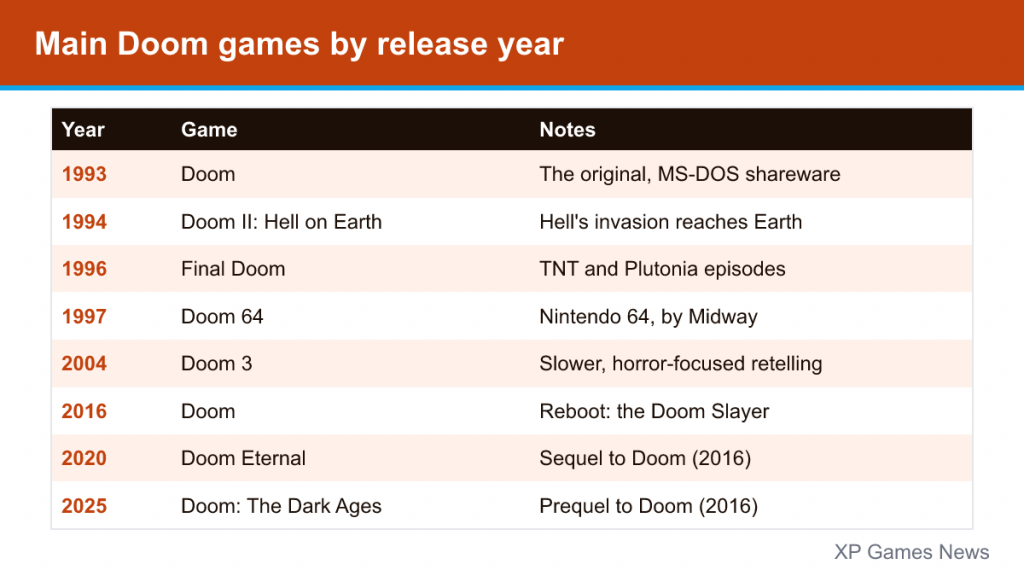
| Release date | Game | Notes |
|---|---|---|
| December 10, 1993 | Doom | The original, released as shareware for MS-DOS |
| October 10, 1994 | Doom II: Hell on Earth | Hell’s invasion reaches Earth |
| June 1996 | Final Doom | Two 32-level episodes, TNT: Evilution and The Plutonia Experiment |
| April 1997 | Doom 64 | A Nintendo 64 sequel developed by Midway with id’s oversight |
| August 3, 2004 | Doom 3 | A slower, horror-focused retelling of the Mars invasion |
| April 2005 | Doom 3: Resurrection of Evil | Expansion |
| October 2012 | Doom 3: BFG Edition | Re-release including the new Lost Mission chapter |
| May 13, 2016 | Doom | The reboot that introduced the modern Doom Slayer games |
| March 20, 2020 | Doom Eternal | Direct sequel to Doom (2016) |
| October 2020 and March 2021 | Doom Eternal: The Ancient Gods, Parts One and Two | Story expansions |
| May 15, 2025 | Doom: The Dark Ages | Prequel to Doom (2016) |
| July 7, 2026 | Doom: The Dark Ages – Revelations | Story expansion |
The classic games have also been re-released many times. In August 2024, id Software and Nightdive Studios released Doom + Doom II, an enhanced edition of the first two games that adds a new episode, Legacy of Rust. Doom 64 received a modern re-release in 2020, which also added a new chapter.
The classic era: Doom, Doom II and friends
The original Doom put the player in the boots of an unnamed space marine, often called “Doomguy” by fans, stationed on the moons of Mars after experiments at a research facility opened a gateway to Hell. Its fast movement, varied weapons such as the shotgun and the BFG 9000, intricate maze-like levels with keycards and secrets, and support for player-made content made it a phenomenon.

Doom II: Hell on Earth (1994) continued the story with Hell invading Earth, introduced the double-barreled super shotgun and new demons, and abandoned the episode structure for a continuous set of levels. Final Doom (1996) offered two new level sets made by community designers who had been brought in to work on the project.
Doom 64 was developed by Midway Games for the Nintendo 64 and served as a sequel to Doom II with new levels and a darker art style. It was largely overlooked for years before the 2020 re-release introduced it to a wider audience.
These games still play remarkably well. Their levels are dense with secrets and alternative routes, and the community has continued to produce new content for decades. John Romero, one of the original designers, released Sigil (2019) and Sigil II (2023) as unofficial episodes.
Doom 3: the horror detour
Doom 3 (2004) took the series in a different direction. Instead of a fast arena shooter, it was a slower, atmospheric game set in the corridors of a Union Aerospace Corporation (UAC) base on Mars. Darkness, scripted scares and a flashlight that originally could not be used at the same time as a weapon defined the experience.
The game is its own continuity, a reimagining of the original’s premise rather than a sequel. It was followed by the Resurrection of Evil expansion (2005), developed by Nerve Software, and the BFG Edition (2012), which added a mounted flashlight and an extra chapter called The Lost Mission.
Doom 3 divides fans. Some love its atmosphere; others feel it moved too far from the series’ identity. Either way, it is not required to understand the modern games.
The modern trilogy: the Doom Slayer saga
The 2016 reboot, simply titled Doom, returned the series to its roots with fast movement and aggressive combat, and introduced a new framing for the hero: the Doom Slayer, a legendary figure feared by demons. Doom Eternal (2020) expanded this mythology dramatically, revealing more of the Slayer’s past, new factions and new worlds. Doom: The Dark Ages (2025) went back in time to tell an earlier chapter of the Slayer’s story.
Doom (2016)
The Slayer awakens in a UAC facility on Mars where demons have been unleashed. The game introduced glory kills, close-range executions that drop health, and a chainsaw that rewards ammo, pushing players to stay aggressive. It also featured an arena-style structure with secrets scattered across levels.
Doom Eternal (2020)
Hell has invaded Earth, and the Slayer must stop it. Eternal added more movement options such as the dash, weapon mods, a flame belch that produces armor and a hub, the Fortress of Doom. It also made combat a precise resource-management puzzle. The Ancient Gods expansions, released in two parts, concluded this storyline.
Doom: The Dark Ages (2025)
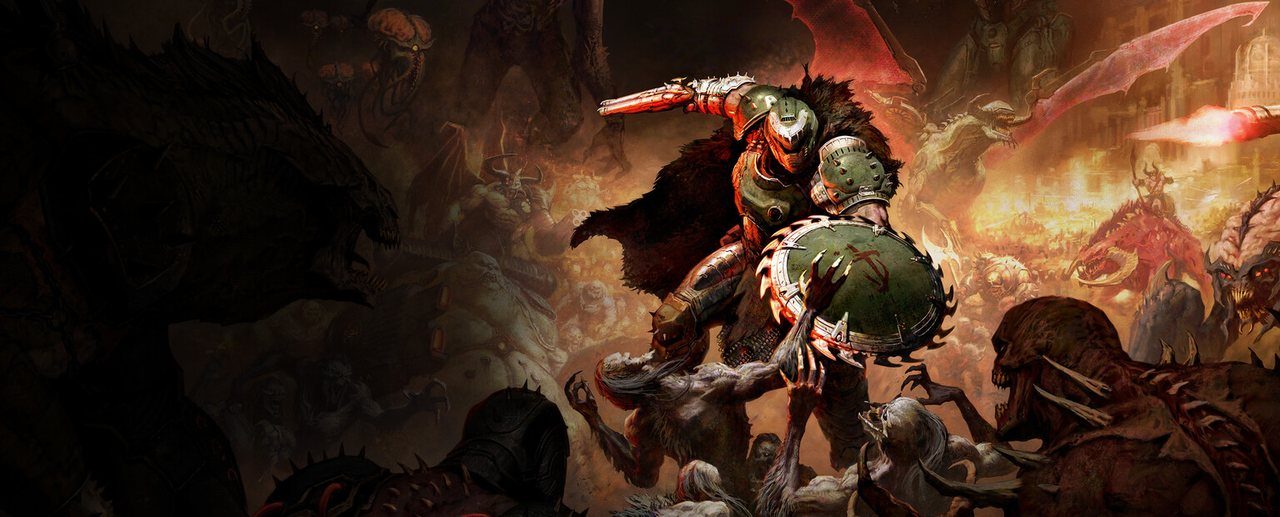
A prequel set before Doom (2016), The Dark Ages depicts the Slayer in a medieval, dark-fantasy setting fighting alongside the Night Sentinels. It changed the feel of combat noticeably: the Slayer carries a Shield Saw that can block, parry and be thrown, and the game emphasizes standing your ground rather than constant dashing. It also includes large-scale sequences such as piloting a giant mech and riding a cybernetic dragon.
Revelations (2026)
The Dark Ages’ story expansion, released on July 7, 2026, puts the Slayer in a purgatory shaped by his own mind and adds new demons and a new throwable weapon, the Chain Spear.
The Doom Slayer story timeline
If you want to follow the modern saga in chronological order of events, it looks like this:
- Doom: The Dark Ages and its Revelations expansion
- Doom (2016)
- Doom Eternal
- Doom Eternal: The Ancient Gods, Parts One and Two
Where do the classic games fit? id Software has deliberately blurred the lines. Doom Eternal includes references suggesting that the classic marine and the Doom Slayer are one and the same, with the Slayer’s earlier adventures forming part of his backstory. Doom 64’s 2020 re-release also added content intended to bridge the classic era and the 2016 game. In practice, most players treat the classic games as legendary background and the modern trilogy as the main story.
Doom 3 sits outside this timeline as a separate continuity.
Release order or story order?
For the modern trilogy, release order is usually recommended: Doom (2016), Doom Eternal, then The Dark Ages. Reasons include:
- Story reveals. Doom Eternal’s lore drops and The Dark Ages’ backstory are written for players who already know the Slayer.
- Mechanical progression. Doom (2016) is the simplest of the three, and Eternal builds on it with more complex systems. Going straight from Eternal to 2016 can feel like losing tools.
Story order, starting with The Dark Ages, is also reasonable. The Dark Ages is accessible, its combat style is distinct from the other two, and its story stands on its own. If you prefer heavier, more grounded combat, it may even be the better entry point.
Where should a newcomer start?
- The best all-round starting point: Doom (2016). It is approachable, fast and establishes the modern formula.
- If you want the most intense, mechanically demanding game: Doom Eternal, but expect a learning curve.
- If you prefer weighty, shield-based combat: Doom: The Dark Ages.
- If you want to understand the legacy: the Doom + Doom II release, which bundles the classic games with modern conveniences.
Doom fits neatly into the same tradition as other single-player shooter series covered on this site, such as Halo’s campaigns and the Call of Duty campaigns, but its focus on speed, aggression and resource management gives it a distinct identity.
Common mistakes for new Doom players
Playing it like a cover shooter. The modern games punish hiding. Health and armor come from killing demons up close, so standing still behind a wall usually makes things worse, not better.
Sticking to one favorite weapon. Doom Eternal in particular is designed around switching weapons constantly, using each gun against the demons it counters best. Ignoring this makes the game feel much harder than it is.
Ignoring the chainsaw. In Doom (2016) and Eternal, the chainsaw is the main way to refill ammo. Running dry in the middle of an arena is a common beginner problem with a simple fix.
Skipping secrets in the classic games. The original levels hide powerful weapons, armor and whole secret areas. Exploring walls and odd corners is part of the design.
Picking a difficulty that is too low. Many players find that the standard difficulty pushes them to learn the combat loop, while the easiest setting removes the tension that makes Doom satisfying. Check each game’s options to see whether difficulty can be changed during a campaign before committing.
Frequently asked questions
Do I need to play the classic games first? No. The modern games recap what you need, though classic references reward longtime fans.
Is Doom 3 part of the main story? No. It is a standalone retelling.
Do I need the expansions? The Ancient Gods concludes Eternal’s story arc, so it is recommended if you want closure. Revelations adds a new chapter to The Dark Ages.
Is Doom a horror series? The classic games and the modern trilogy are action-first, with a heavy-metal tone. Doom 3 is the most horror-leaning entry.