Assassin’s Creed Games in Order: Release Order vs Historical Timeline
Every main Assassin's Creed game by release year and by historical setting, from ancient Greece to feudal Japan, plus a quick guide to the modern-day story.
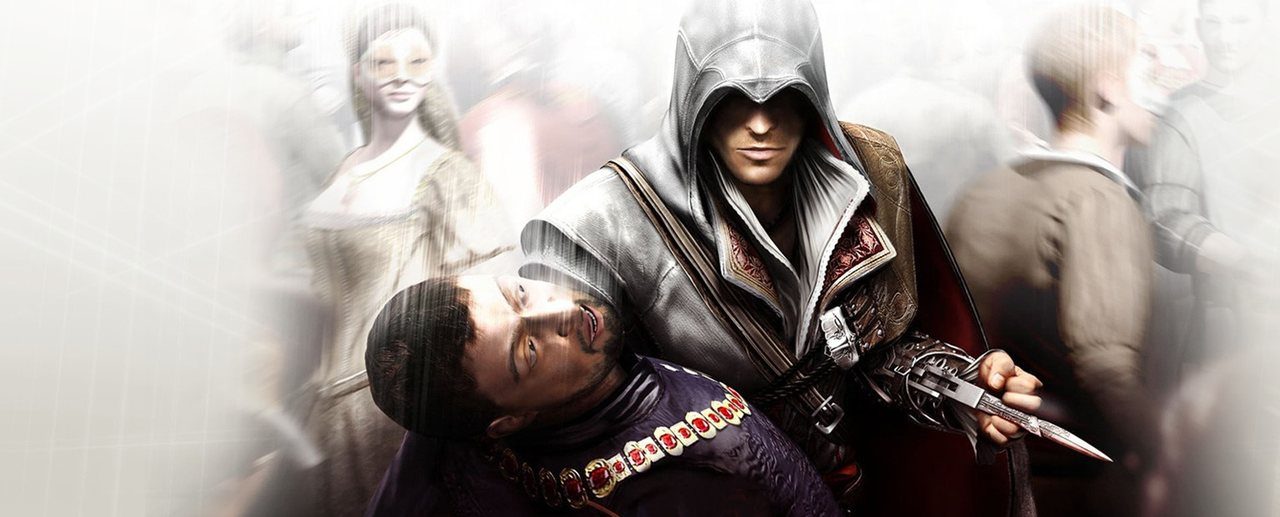
Assassin’s Creed is unusual among long-running series because its games do not move forward in time. Each one drops you into a different historical period, so the order in which Ubisoft released the games and the order in which their stories take place are completely different. A player who starts with the newest game might be in 16th-century Japan, while the next one they pick up is set in ancient Egypt.
This guide lays out both orders side by side, explains the modern-day framing story that ties them together, and offers suggestions on how to approach the series. It covers the fourteen main console and PC games through Assassin’s Creed Shadows (2025), plus a note on the 2026 Black Flag remake.
How the series’ framing works
Before the lists, a quick explanation of why the timeline jumps around. In the series’ fiction, a machine called the Animus lets people in the present day relive the genetic memories of their ancestors. Each game’s historical adventure is technically a memory being explored by someone in the modern world. That device lets Ubisoft set each game anywhere in history while keeping a connecting thread: the long war between the Assassins (and their predecessors, the Hidden Ones) and the Templars (and their predecessors, the Order of the Ancients), and the mystery of an ancient precursor civilization, the Isu.
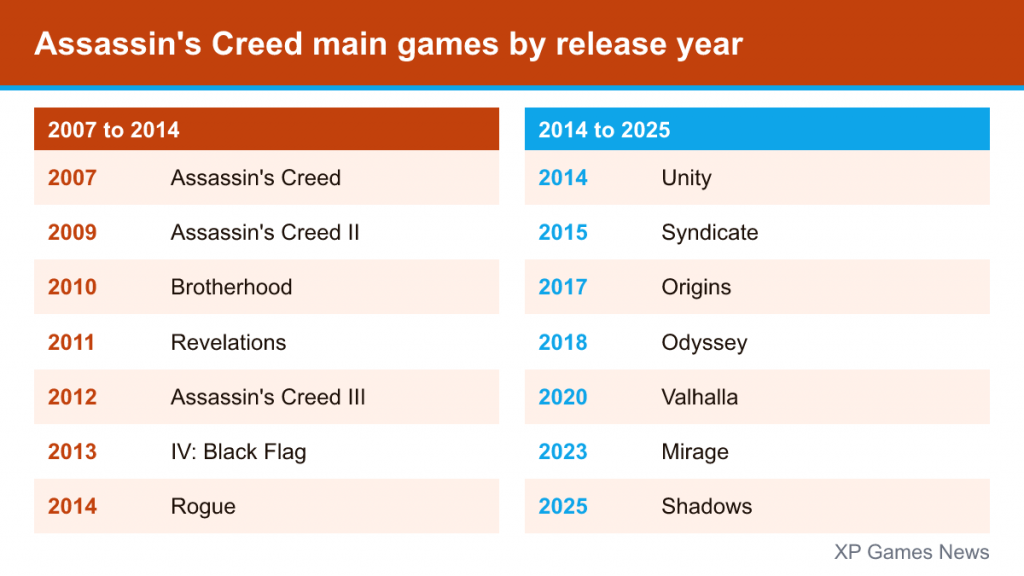
Main games in release order
| Release year | Game | Setting | Main protagonist(s) |
|---|---|---|---|
| 2007 | Assassin’s Creed | Holy Land during the Third Crusade | Altaïr Ibn-La’Ahad |
| 2009 | Assassin’s Creed II | Renaissance Italy (Florence, Venice) | Ezio Auditore da Firenze |
| 2010 | Assassin’s Creed Brotherhood | Renaissance Rome | Ezio Auditore |
| 2011 | Assassin’s Creed Revelations | Constantinople | Ezio Auditore (with Altaïr) |
| 2012 | Assassin’s Creed III | Colonial America and the American Revolution | Haytham Kenway, Ratonhnhaké:ton (Connor) |
| 2013 | Assassin’s Creed IV: Black Flag | Caribbean, Golden Age of Piracy | Edward Kenway |
| 2014 | Assassin’s Creed Rogue | North America, Seven Years’ War era | Shay Patrick Cormac |
| 2014 | Assassin’s Creed Unity | Paris during the French Revolution | Arno Dorian |
| 2015 | Assassin’s Creed Syndicate | Victorian London | Jacob and Evie Frye |
| 2017 | Assassin’s Creed Origins | Ptolemaic Egypt | Bayek of Siwa (with Aya) |
| 2018 | Assassin’s Creed Odyssey | Ancient Greece, Peloponnesian War | Alexios or Kassandra |
| 2020 | Assassin’s Creed Valhalla | Viking-age Norway and England | Eivor |
| 2023 | Assassin’s Creed Mirage | Baghdad, 9th century | Basim Ibn Ishaq |
| 2025 | Assassin’s Creed Shadows | Feudal Japan, Sengoku period | Naoe and Yasuke |
Ubisoft also released Assassin’s Creed Black Flag Resynced, a ground-up remake of Black Flag, on July 9, 2026 for PlayStation 5, Xbox Series X|S and PC. It retells Edward Kenway’s story with rebuilt combat, stealth and parkour, and does not change the historical timeline.
Main games in historical order
Sorted by when each game’s main historical story takes place, the series looks very different:
| Historical period | Game |
|---|---|
| 431-422 BCE | Assassin’s Creed Odyssey |
| 49-43 BCE | Assassin’s Creed Origins |
| 861 CE | Assassin’s Creed Mirage |
| 872-878 CE | Assassin’s Creed Valhalla |
| 1191 | Assassin’s Creed |
| Late 15th century | Assassin’s Creed II |
| 1499-1507 | Assassin’s Creed Brotherhood |
| 1511-1512 | Assassin’s Creed Revelations |
| 1579-1581 | Assassin’s Creed Shadows |
| 1715-1722 | Assassin’s Creed IV: Black Flag |
| 1750s | Assassin’s Creed Rogue |
| 1754-1783 | Assassin’s Creed III |
| 1789-1794 | Assassin’s Creed Unity |
| 1868 | Assassin’s Creed Syndicate |
A few notes on overlap. Mirage and Valhalla are closely linked because Basim appears in Valhalla before getting his own origin story in Mirage, which is set earlier. Rogue overlaps with Assassin’s Creed III, and several characters appear in both, while Black Flag introduces the Kenway family whose descendants lead III. Some games also include sections set outside their main period; Syndicate, for example, has a World War I segment.
The connected sagas within the series
Even though settings jump around, certain games form tight story arcs that are best played together.
The Ezio trilogy
Assassin’s Creed II, Brotherhood and Revelations follow Ezio from youth to old age. They are frequently cited as the series’ high point for character writing and are best played in order. They were collected as The Ezio Collection.
The Kenway saga
Black Flag, Rogue and Assassin’s Creed III all involve the Kenway family or characters connected to them. Release order works fine, but playing Black Flag first gives context for Haytham Kenway’s role in III, since Haytham is Edward’s son.
The origins arc
Origins tells how the Hidden Ones, the forerunners of the Assassins, were formed. Odyssey is set earlier but deals more with the Isu and the series’ mythology than with the Assassin-Templar war. Valhalla and Mirage then link back through the Hidden Ones and Basim.
The modern-day storyline, briefly
The modern-day plot has been both a strength and a source of confusion. Here is the short version, kept light on spoilers:
- Desmond Miles (Assassin’s Creed to Assassin’s Creed III). A bartender descended from Assassins is kidnapped by Abstergo, the modern face of the Templars, and forced to relive ancestral memories. His story runs through the first five main games and concludes in Assassin’s Creed III.
- The Abstergo era (Black Flag to Syndicate). After Desmond, modern-day sections became shorter and more abstract. Black Flag casts the player as an unnamed employee at an Abstergo entertainment division, and later games frame the player as a user of Abstergo’s Helix software.
- Layla Hassan (Origins to Valhalla). A former Abstergo researcher builds her own portable Animus and becomes involved with the modern Assassins. Her arc concludes at the end of Valhalla.
- Recent games. Mirage and Shadows put much less emphasis on modern-day gameplay, focusing almost entirely on their historical stories. Shadows uses a menu-based hub tied to the Animus rather than playable present-day scenes.
If the modern story matters to you, release order is the only sensible approach, because the present-day plot advances game by game. If you mainly care about history and gameplay, you can largely ignore it.
Classic era vs modern era gameplay
One more factor matters for choosing an order: the series changed significantly with Origins in 2017, moving closer to the RPG side of the open-world action-adventure spectrum. The social stealth that defined the early games is covered in our guide to stealth subgenres.
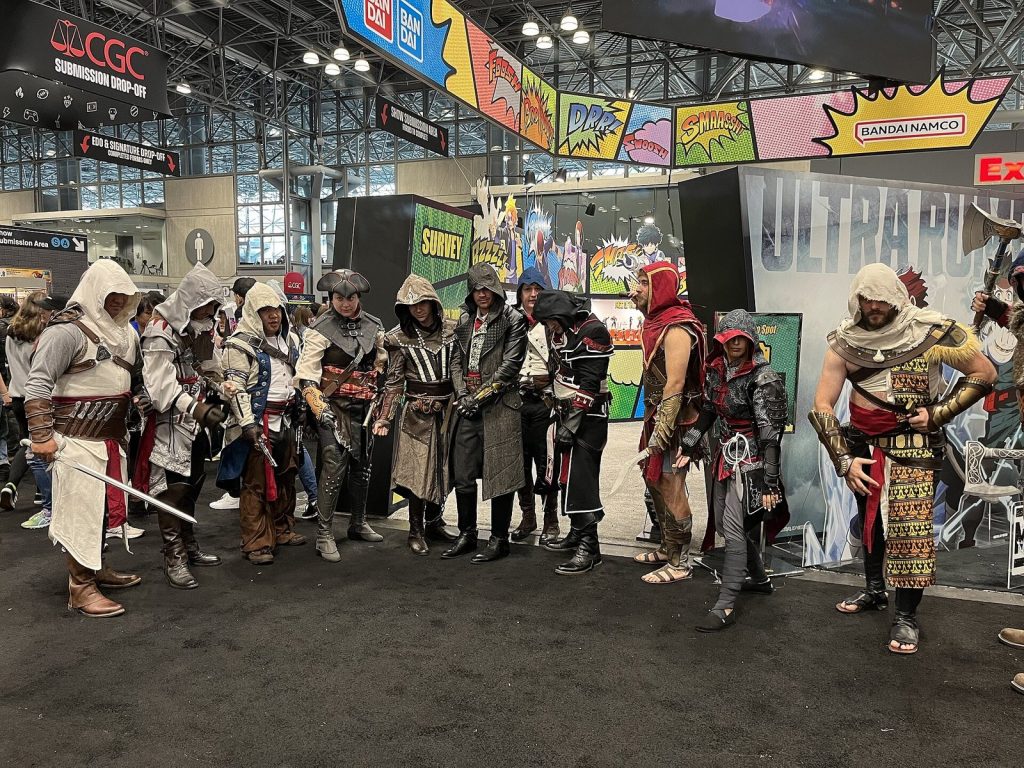
- Classic era (2007-2015): Compact cities, climbing-focused traversal, social stealth in crowds, and timing-based counter combat. Missions are often tightly structured.
- Modern era (Origins, Odyssey, Valhalla): Very large maps, experience levels and gear, hitbox-based combat, and many more optional activities.
- Mirage (2023): A deliberate return to a smaller city and stealth-first assassination design, often described as a homage to the original game.
- Shadows (2025): Two protagonists with different styles: Naoe, a stealthy shinobi, and Yasuke, a powerful samurai, in a large open world with seasons.
Jumping from a modern-era game back to the 2007 original can be jarring, and vice versa. Many players pick one era to explore first.
Recommended ways to play
Release order is the best choice for anyone who wants the full story, including the modern-day plot, and wants to see mechanics evolve naturally. Its drawback is that the first game feels repetitive by today’s standards.
Historical order is a fun experiment for history fans, but it scrambles the modern-day story and means switching between very different gameplay styles. Starting with Odyssey and then going to Origins also exposes you to two of the largest and longest games back to back.
Pick an era is often the most practical approach. Some suggestions:
- Want classic stealth and parkour? Start with Assassin’s Creed II and continue through the Ezio trilogy, or try Mirage for a modern take on the same ideas.
- Want a sailing adventure? Black Flag stands well on its own, in either its 2013 form or the 2026 remake.
- Want a huge world to explore? Origins or Odyssey.
- Want the newest experience? Shadows, which needs no prior knowledge to follow its main story.
Common mistakes when choosing an order
Treating every game as equally essential. With fourteen main entries, trying to play them all in sequence is a huge commitment, and the modern-era games each run for dozens of hours. It is better to choose the arcs that interest you than to burn out halfway through.
Starting the Ezio trilogy in the middle. Brotherhood and Revelations assume you know Ezio’s story from Assassin’s Creed II. They are much less rewarding on their own.
Expecting the modern-day plot to resolve neatly. The present-day story changed direction several times over the years. Treat it as a framing device rather than the main attraction, and the historical stories will carry you.
Judging the whole series by one era. Someone who bounces off the slower, stat-driven Odyssey might love the tight city stealth of Unity or Mirage, and the reverse is just as common. If one game does not click, try one from the other era before giving up.
Ignoring remastered versions. Several older entries have been re-released for newer platforms, including collections of the Ezio trilogy and remasters of Rogue and Assassin’s Creed III. These are usually the easiest way to play the older games today.
Frequently asked questions
Do I need to play the first game? No. It is historically important, and the foundations of the series are here, but many players start with Assassin’s Creed II and lose little.
Which game should I play before Mirage? Mirage is designed to be standalone, though Valhalla provides background on Basim’s later life.
Are the spin-offs important? Handheld titles and side-scrolling spin-offs such as the Chronicles trilogy are optional. Assassin’s Creed Liberation (2012), originally a PlayStation Vita game, was later remastered and fits into the same era as III.
Is the Black Flag remake a replacement for the original? It is a remake of the same story with rebuilt systems and some added content, according to Ubisoft. Either version tells Edward Kenway’s tale.