Metal Gear Solid Series Guide: Play Order and Story Timeline
Metal Gear Solid in release order and story order, where the MSX games fit, what the Master Collections include, and how Delta fits in.

Metal Gear Solid is one of the most influential stealth series ever made, and also one of the most confusing to approach. Its story jumps back and forth across five decades, several important games were stuck on older hardware for years, and the timeline is full of clones, double agents and characters with codenames. This guide untangles it: the release order, the story order, where the 1980s MSX games fit, what Konami’s Master Collection releases contain, and how the 2025 remake Metal Gear Solid Delta: Snake Eater fits in.
The main games in release order
| Year | Game | Original platform |
|---|---|---|
| 1987 | Metal Gear | MSX2 |
| 1990 | Metal Gear 2: Solid Snake | MSX2 |
| 1998 | Metal Gear Solid | PlayStation |
| 2001 | Metal Gear Solid 2: Sons of Liberty | PlayStation 2 |
| 2004 | Metal Gear Solid 3: Snake Eater | PlayStation 2 |
| 2006 | Metal Gear Solid: Portable Ops | PSP |
| 2008 | Metal Gear Solid 4: Guns of the Patriots | PlayStation 3 |
| 2010 | Metal Gear Solid: Peace Walker | PSP |
| 2014 | Metal Gear Solid V: Ground Zeroes | PlayStation 3/4, Xbox 360/One |
| 2015 | Metal Gear Solid V: The Phantom Pain | PlayStation 3/4, Xbox 360/One, PC |
| 2025 | Metal Gear Solid Delta: Snake Eater (remake) | PlayStation 5, Xbox Series X|S, PC |
The series was created by Hideo Kojima, who directed the main entries through The Phantom Pain. Delta was developed by Konami after his departure. There are also side games, most notably Metal Gear Rising: Revengeance (2013), an action spin-off developed with PlatinumGames, and Metal Gear: Ghost Babel (2000), a Game Boy Color game set in an alternate continuity.
The story in chronological order
The main saga follows two generations: Big Boss, the legendary soldier, and his “son” Solid Snake. The games set earliest in the timeline are about Big Boss, even though they were released later.
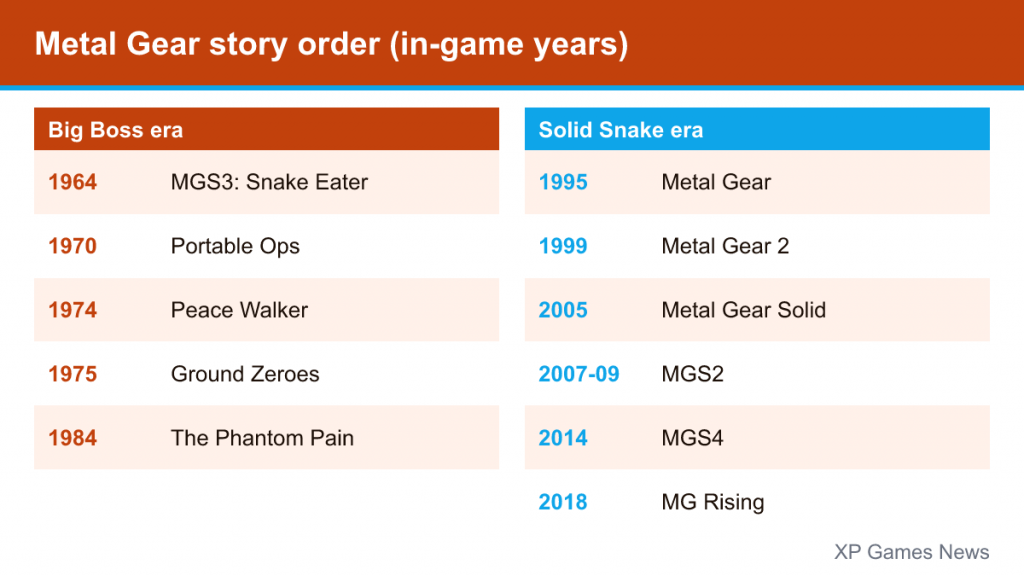
- Metal Gear Solid 3: Snake Eater / Delta – 1964. Naked Snake, who will become Big Boss, infiltrates the Soviet Union.
- Metal Gear Solid: Portable Ops – 1970. Snake forms a unit after a mission goes wrong in South America.
- Metal Gear Solid: Peace Walker – 1974. Big Boss leads his private army, Militaires Sans Frontières, in Costa Rica.
- Metal Gear Solid V: Ground Zeroes – 1975. A short prologue to The Phantom Pain.
- Metal Gear Solid V: The Phantom Pain – 1984. Big Boss returns in Afghanistan and Central Africa.
- Metal Gear – 1995. Solid Snake’s first mission, in Outer Heaven.
- Metal Gear 2: Solid Snake – 1999. Snake infiltrates Zanzibar Land.
- Metal Gear Solid – 2005. The Shadow Moses incident.
- Metal Gear Solid 2: Sons of Liberty – 2007 and 2009. The Tanker and Big Shell chapters.
- Metal Gear Solid 4: Guns of the Patriots – 2014. An aging Snake’s final mission.
- Metal Gear Rising: Revengeance – 2018. Raiden’s action spin-off, set after MGS4.
Release order or story order?
Most fans recommend release order, or something close to it, for a few reasons.
- Story reveals depend on it. The later prequels assume you know the original characters. MGS3’s ending, for instance, recontextualizes figures you met in earlier games. Many of MGS2’s twists also play on expectations created by MGS1.
- Gameplay evolves gradually. Starting with The Phantom Pain, an open-world game with modern controls, and then jumping to the 1987 original is a big step backward.
- The series was written that way. Each sequel was designed as a response to the previous game.
A practical compromise, popular with newcomers, is to begin with Metal Gear Solid (1998) and play the numbered games in release order, treating the MSX games as optional background. Many players read a summary of the two MSX games before starting MGS1, because MGS1’s story references them heavily.
Starting with Metal Gear Solid 3 is the main alternative. It is the earliest story chapter, it stands well on its own, and the Delta remake makes it the most modern way into the series. You lose some of the impact of its connections to later games, but you gain a strong, accessible first experience.
Where the MSX games fit
Metal Gear (1987) and Metal Gear 2: Solid Snake (1990) were released on the MSX2, a home computer platform popular in Japan and parts of Europe. They are top-down stealth games and established many series staples: infiltrating alone, avoiding guards rather than fighting them, using radio contacts, and confronting Big Boss.
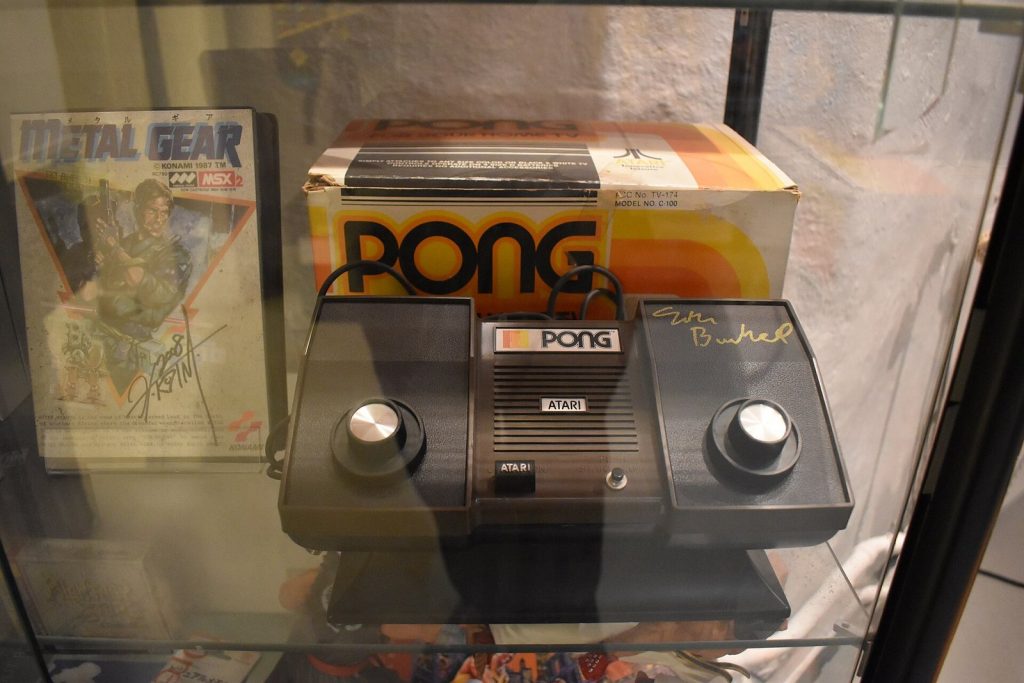
They are canon and important, since Metal Gear Solid is effectively a sequel to them. But because they look and play very differently from the 3D games, many players skip them or watch summaries. If you are patient and enjoy older games, Metal Gear 2 in particular holds up well and introduced ideas such as guards with a field of vision and the ability to crawl.
The NES release of Metal Gear differed from the MSX2 original, and the NES sequel Snake’s Revenge (1990) was made without Kojima’s involvement. Neither is part of the main canon.
Master Collection Vol. 1 and Vol. 2
For years, playing the whole saga required several generations of hardware. Konami’s Master Collection releases changed that.
Metal Gear Solid: Master Collection Vol. 1 (2023) includes:
- Metal Gear and Metal Gear 2: Solid Snake (MSX2 versions)
- Metal Gear Solid, including content from its Integral version and VR Missions
- Metal Gear Solid 2: Sons of Liberty
- Metal Gear Solid 3: Snake Eater
- The NES versions of Metal Gear and Snake’s Revenge as bonus games
- Digital extras such as screenplays, Master Book dossiers and the Digital Graphic Novel motion comics
Vol. 1 launched on October 24, 2023 for PlayStation 4, PlayStation 5, Xbox Series X|S, Nintendo Switch and PC.
Metal Gear Solid: Master Collection Vol. 2 was released on August 27, 2026 and includes Metal Gear Solid 4: Guns of the Patriots, making its first appearance outside PlayStation 3, along with Metal Gear Solid: Peace Walker (HD Collection version) and Metal Gear: Ghost Babel. It was released on PlayStation 5, Xbox Series X|S, Nintendo Switch, Nintendo Switch 2 and PC.
Between the two volumes and Metal Gear Solid V, which remains available on modern platforms through backward compatibility and PC, almost the entire main saga can now be played on current hardware. Portable Ops is the most notable main-timeline game not included in either volume.
Metal Gear Solid Delta: Snake Eater
Metal Gear Solid Delta: Snake Eater, released on August 28, 2025, is a full remake of Metal Gear Solid 3 built in Unreal Engine 5. Konami developed it with support from the studio Virtuos, and kept the original story, structure and recorded voice performances while rebuilding the visuals.
Delta offers two control schemes. New Style uses modern third-person action controls with a free camera, while Legacy Style recreates the original’s controls and overhead camera. Other changes include visible wear on Snake’s body, such as scars and damage that persist through a playthrough, the return of the Snake vs. Monkey minigame on PlayStation 5 and PC (the Xbox version has a Bomberman-themed alternative), and an online mode, Fox Hunt, which was added after launch in October 2025.
For a new player, Delta is arguably the easiest entry point into the whole series: it is the beginning of the timeline, it has modern presentation, and it does not require knowledge of the other games. Its story does gain extra layers once you play the Solid Snake games, though, so think of it as a strong first chapter rather than the whole picture.
How the gameplay changes across the series
Knowing how each era plays helps set expectations, especially if you move between old and new entries.
- MSX era: Top-down, screen-by-screen infiltration with simple guard behavior. The foundations of the series’ stealth are here, but the games are demanding by modern standards.
- Metal Gear Solid and MGS2: 3D environments viewed mostly from an overhead camera, with a radar showing enemy positions and their fields of view. MGS2 added more detailed guard behavior and the ability to hold up enemies at gunpoint.
- MGS3: The setting moves outdoors into the jungle. The radar is gone, replaced by camouflage, a camo index showing how well you blend in, and survival systems such as stamina, food and treating injuries.
- MGS4 and Peace Walker: More action-oriented controls, an over-the-shoulder camera in MGS4, and mission-based structure with base building in Peace Walker.
- Metal Gear Solid V: Open-world regions, a day-night cycle, buddies, Mother Base management and approach-it-any-way design.
The common thread is that avoiding combat is usually smarter than seeking it, and the games often reward non-lethal play.
Suggested play paths
The classic path
Read summaries or play Metal Gear and Metal Gear 2, then play MGS1, MGS2, MGS3, MGS4, Peace Walker, Ground Zeroes and The Phantom Pain. Portable Ops can be slotted in after MGS3 if you can access it.
The Big Boss-first path
Play MGS3 (or Delta), Peace Walker, Ground Zeroes and The Phantom Pain, then go back to MGS1, MGS2 and MGS4. This is close to chronological order and works well, though some reveals will hit differently.
The just-get-started path
Play Metal Gear Solid Delta. If you enjoy it, move on to Metal Gear Solid and continue in release order from there.
Tips for newcomers to the series
- Expect long cutscenes and radio calls. The series is famous for them. They are part of the experience.
- Experiment. The games reward curiosity with unusual interactions and secrets.
- Use non-lethal options. Tranquilizers and chokeholds are often the most effective tools and suit the series’ themes.
- Do not worry about understanding everything. Even longtime fans debate the plot. Enjoy the ride.
Our guide to how detection works in stealth games explains the alert phases that Metal Gear helped popularize, and our overview of stealth subgenres covers tactical espionage alongside other styles.