Hitman: World of Assassination Beginner’s Guide
What Hitman: World of Assassination includes, how a level works, and how disguises, Instinct, Mission Stories, Silent Assassin and mastery fit together.

Hitman: World of Assassination is one of the best stealth games available, but it can be intimidating at first. Its levels are large and busy, its menus list dozens of challenges, and the game seems to expect you to fail and try again. That expectation is the key to enjoying it. Each location is designed to be played many times, and the real game is learning a map well enough to pull off a perfect hit.
This guide explains what World of Assassination includes, how a typical level works, and the core systems every new player should understand.
What World of Assassination is
IO Interactive’s modern Hitman trilogy consists of three games: Hitman (2016), Hitman 2 (2018) and Hitman 3 (2021). In January 2023, IO Interactive rebranded Hitman 3 as Hitman: World of Assassination, turning it into a single hub that holds the content of all three games. Owners of the earlier games could carry their content over, and the rebrand also introduced Freelancer, a roguelike-style mode.
The result is one launcher containing more than 20 locations across the trilogy. IO Interactive also offers a free demo, which replaced the earlier Free Starter Pack, and a separate purchase called World of Assassination Part One, which contains the six main locations from Hitman (2016). Editions and store bundles change over time, so check the store listing on your platform to see exactly what is included before you buy.
The game is available on PlayStation, Xbox and PC, and IO Interactive has expanded it to further platforms over time, including PS VR2 and Nintendo Switch 2 in 2025.
The locations in the trilogy
| Original game | Main locations |
|---|---|
| Hitman (2016) | Paris, Sapienza, Marrakesh, Bangkok, Colorado, Hokkaido, plus the ICA Facility training prologue |
| Hitman 2 (2018) | Hawke’s Bay, Miami, Santa Fortuna, Mumbai, Whittleton Creek, Isle of Sgàil, plus the New York and Haven Island expansion locations |
| Hitman 3 (2021) | Dubai, Dartmoor, Berlin, Chongqing, Mendoza, the Carpathian Mountains, plus Ambrose Island, added in 2022 |
The campaign tells one connected story across all three games, but each mission is self-contained. You can play the locations in order to follow the plot, or jump to whichever map interests you.
Where should a beginner start?
The best starting point is the beginning of the Hitman (2016) campaign: the ICA Facility training missions followed by Paris. The training levels introduce the basics in a controlled setting. Paris, a fashion show in a large palace, is one of the most celebrated levels in the series and demonstrates almost every mechanic you will use later.
Sapienza, a coastal Italian town, is often cited as a favorite and works well as a second level. If you want a smaller, simpler map, Hawke’s Bay from Hitman 2 is compact enough to learn quickly. The Carpathian Mountains finale of Hitman 3 is linear and unusual, so it is not a good first mission.
How a Hitman level works
Each mission follows a similar structure. You start at an entry point, usually in a suit, with a briefing that describes your targets. Targets move around the map following routines. Your job is to eliminate them and leave through one of several exits.
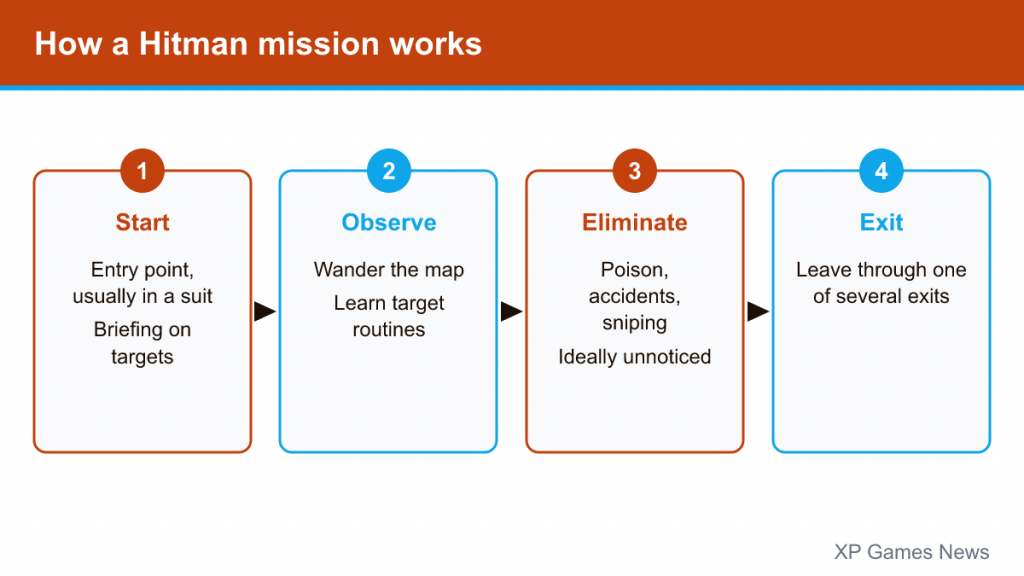
The fun lies in how you do it. Hitman levels are dense sandboxes full of people, objects and opportunities. You can poison a drink, drop a chandelier, push someone off a balcony, sabotage equipment, or use a sniper rifle from a distance. Many methods can be staged to look like accidents, which avoids alarming the people around the target. For a general picture of how sandbox assassination fits into the genre, see our guide to stealth subgenres.
A first run of a level often involves a lot of wandering, observation and improvisation. That is normal. You are learning the map.
Disguises and enforcers
Disguises are Hitman’s signature mechanic. You can take the clothing of anyone you subdue and use it to access areas reserved for that role. A waiter’s outfit gets you into a kitchen; a security uniform opens guarded areas.

Disguises are not perfect, though. Certain characters, called enforcers, can see through specific outfits. A head chef, for example, may notice that you are not a real member of the kitchen staff. When you use Instinct, enforcers who could recognize your current disguise are marked, so you know whom to avoid.
Your behavior matters too. Running, climbing, carrying a weapon openly or doing something illegal will draw attention even if you are in a disguise that grants access. Some areas are off-limits to everyone except particular roles, and trespassing there causes characters to react.
Instinct: your planning tool
Instinct is a vision mode that highlights important information. It shows targets through walls, marks items you can interact with, and identifies enforcers. It is extremely useful for tracking targets as they move around a level and for spotting opportunities you might otherwise miss.
Some players reduce or turn off Instinct and other helpers once they know the maps, but there is no shame in leaning on it heavily as a beginner. It is part of the game’s design, not a cheat. Our explainer on how enemy detection works in stealth games covers how Instinct compares with similar tools in other series.
Mission Stories: guided opportunities
Every main location contains several Mission Stories, guided sequences that lead you to a particularly elaborate or entertaining way to eliminate a target. You usually discover them by overhearing conversations or picking up items. Once a Mission Story is active, the game can provide step-by-step guidance on screen.
For beginners, Mission Stories are invaluable. They teach you a map’s layout, introduce you to useful disguises and items, and show you how the game expects targets to be lured into vulnerable positions. A common approach is to follow Mission Stories on your first few runs, then experiment with your own methods once you know the map.
If the guidance feels too hand-holding, the game’s options let you adjust how much help is shown.
Ratings and Silent Assassin
At the end of a mission, the game rates your performance. The most famous goal is the Silent Assassin rating, the series’ traditional mark of a perfect hit. While the exact scoring details are more complex, the general principles are well known among players:
- Kill only your targets. Eliminating anyone else, including guards, costs you the rating.
- Do not be spotted committing crimes or noticed as suspicious.
- Make sure no bodies are found. Accidents are treated more leniently than obvious murders.
- Destroy or erase any security camera recordings of yourself.
Silent Assassin is optional. You can complete a mission in a messy shootout and still progress. But aiming for it teaches you the precise, careful style that Hitman rewards. Variants such as Silent Assassin, Suit Only, which requires completing a mission without changing out of your suit, add further challenge for experienced players.
Challenges, mastery and unlocks
Each location has a long list of challenges: specific kills, discoveries, disguises to find and feats to perform. Completing them earns experience toward the location’s mastery level. As mastery increases, you unlock new starting locations, places where items can be hidden in advance, and new equipment.
This system is designed to make replays feel rewarding. On your second or third run, you might start the level in a kitchen disguise, with a poison vial stashed in a convenient spot, ready to attempt a method you could not reach before.
Gear unlocked through mastery carries across the campaign, so playing one map deeply can make others easier.
Choosing a difficulty
The main missions offer three difficulty settings: Casual, Professional and Master. Casual is the most forgiving and is a sensible choice if you mainly want to enjoy the stories and sandboxes. Professional is the standard experience. Master is designed for players who already know the maps: it limits saving and makes levels more demanding, for example by adding more watchful guards and security measures.
A common path is to learn each location on Casual or Professional, then return on Master once you know where everything is. Because mastery progress and unlocks carry over, time spent on easier settings is never wasted.
Other modes, briefly
- Escalations are multi-stage contracts on existing maps that add new complications at each stage.
- Contracts mode lets players mark any character as a target and share the resulting contract with others.
- Elusive Targets are special time-limited targets that appear on existing maps, traditionally playable only once.
- Freelancer is a roguelike-style mode in which 47 works without Agency support across a campaign of contracts. It is a substantial mode in its own right, best tried once you are comfortable with the main campaign.
Beginner tips
- Save often. On standard difficulty you can make manual saves. Use them before risky moves.
- Follow targets for a while. Their routines often reveal moments when they are alone.
- Listen. Overheard conversations are the best way to discover opportunities.
- Use coins as distractions. Throwing a coin is a simple way to move a guard out of position.
- Hide bodies immediately. Containers are scattered around every map for this reason.
- Do not obsess over perfection on your first run. The first run is for learning. The perfect run comes later.
- Replay. Hitman is not designed to be played once. Returning to a level with new knowledge is the core of the game.
Hitman rewards curiosity more than reflexes. Watch, listen and experiment, and the levels gradually transform from confusing mazes into elaborate playgrounds you know inside out.