
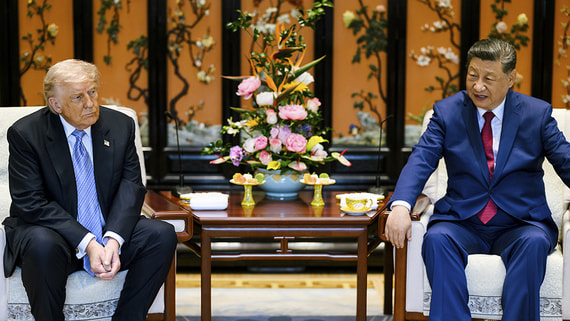
The relationship between the world’s two largest economies has become one of the most consequential geopolitical dynamics of the 21st century. At the recent Summer Davos forum in Dalian, China, leading experts and policymakers gathered to discuss the escalating tensions between Washington and Beijing, with many invoking the ancient concept of the “Thucydides Trap” to describe the precarious situation both nations find themselves in. The term, which refers to the dangerous dynamic that occurs when a rising power threatens to displace an established one, has become increasingly relevant as competition between the United States and China intensifies across economic, technological, and military domains.
Understanding the Thucydides Trap in Modern Context
The Thucydides Trap derives its name from the ancient Greek historian Thucydides, who chronicled the Peloponnesian War between Athens and Sparta in the 5th century BCE. In his famous analysis, Thucydides concluded that “it was the rise of Athens and the fear that this instilled in Sparta that made war inevitable.” Harvard professor Graham Allison popularized this concept in his 2017 book “Destined for War: Can America and China Escape Thucydides’s Trap?” In his research, Allison examined 16 historical cases over the past 500 years where a rising power challenged a ruling one, finding that 12 of these rivalries ended in war. The historical precedents include the rivalry between Germany and Britain before World War I, and the Cold War competition between the United States and the Soviet Union, which notably avoided direct military conflict.
Experts at the Summer Davos emphasized that while historical patterns are concerning, they are not deterministic. The nuclear age, unprecedented economic interdependence, and complex global supply chains create powerful incentives for both nations to avoid direct confrontation. However, the structural pressures described by Thucydides remain potent forces shaping the behavior of both Washington and Beijing. The psychological dimensions of the trap—fear, honor, and interest—continue to influence decision-making on both sides of the Pacific.
Economic Competition and Technological Rivalry
The economic dimensions of US-China competition have intensified dramatically in recent years. Trade tensions, which escalated significantly during the Trump administration with the imposition of tariffs on hundreds of billions of dollars worth of Chinese goods, have continued under subsequent administrations. The Biden administration has maintained many of these tariffs while adding new restrictions, particularly in the technology sector. Export controls on advanced semiconductors and chip-making equipment have become a central battleground, with the United States attempting to limit China’s access to cutting-edge technologies that could enhance its military capabilities and economic competitiveness.
China, for its part, has responded by accelerating efforts to achieve technological self-sufficiency. The “Made in China 2025” initiative and subsequent industrial policies have poured massive resources into developing domestic capabilities in semiconductors, artificial intelligence, quantum computing, and other strategic technologies. Chinese officials have framed these efforts as necessary responses to what they perceive as American containment strategies. At the Summer Davos, Chinese participants emphasized that decoupling would be mutually harmful and that cooperation remains essential for addressing global challenges such as climate change and pandemic preparedness.
Military Dimensions and Regional Flashpoints
Beyond economics, military competition adds another dangerous dimension to the US-China rivalry. The Taiwan Strait remains the most volatile potential flashpoint, with Chinese leaders consistently stating that reunification is a core national interest while the United States maintains its commitment to providing Taiwan with defensive capabilities. The South China Sea, where China has constructed artificial islands and asserted expansive territorial claims, represents another area of persistent tension. American freedom of navigation operations regularly challenge Chinese claims, creating opportunities for miscalculation and escalation.
Defense analysts note that China’s military modernization has been remarkable in both scope and speed. The People’s Liberation Army Navy now operates more ships than the US Navy, though American vessels remain more capable on average. China’s nuclear arsenal is expanding, its hypersonic missile capabilities have advanced rapidly, and its space and cyber capabilities continue to develop. These trends have prompted significant increases in US defense spending and a strategic reorientation toward the Indo-Pacific region, further fueling the competitive dynamic that characterizes the Thucydides Trap.
Pathways Forward and Expert Perspectives
Despite the concerning trajectory, experts at the Summer Davos identified potential pathways for managing competition and avoiding conflict. Maintaining open channels of communication, establishing guardrails for military encounters, and identifying areas of mutual interest where cooperation remains possible were cited as essential elements of a stable relationship. Climate change, global health security, and nuclear nonproliferation represent areas where US-China cooperation could yield significant benefits for both nations and the world. Some analysts advocate for a new framework of “competitive coexistence” that acknowledges fundamental differences while preventing rivalry from spiraling into confrontation.
The coming years will test whether the United States and China can navigate the treacherous waters of great power competition without succumbing to the pattern identified by Thucydides nearly 2,500 years ago. Both nations possess the resources, the historical awareness, and the incentives to chart a different course. Whether they possess the political will and diplomatic skill to do so remains the defining question of contemporary international relations.
Expert Opinion: The US-China relationship has entered a structural phase of strategic competition that will likely persist for decades regardless of leadership changes in either capital. The key variable determining whether this rivalry remains manageable or becomes catastrophic will be the strength of institutional mechanisms for crisis management and the willingness of both sides to accept limitations on their freedom of action. History suggests that avoiding the Thucydides Trap requires conscious, sustained effort—and even then, success is far from guaranteed.