How Enemy Detection Works in Stealth Games: Vision Cones, Sound and Alert States
How stealth game guards see and hear you: vision cones, detection meters, light, noise, alert phases and why a discovered body changes everything.
Every stealth game is built on a promise: if you are careful, the enemies will not notice you. Keeping that promise requires a detection system that is consistent enough for players to learn and flexible enough to feel alive. Guards need to see, hear and react in ways that make sense, and the game needs to communicate those reactions clearly so that failure feels fair.
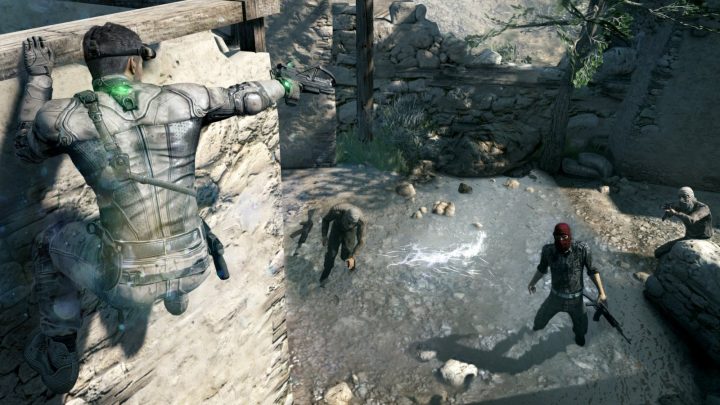
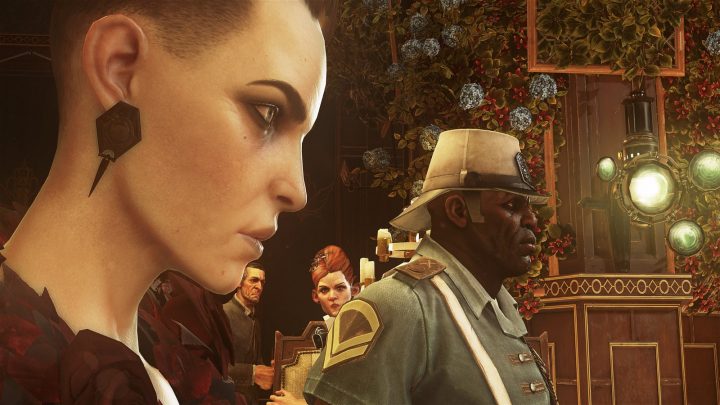
This guide explains the building blocks of detection that appear across the genre, with examples from Splinter Cell, Metal Gear Solid V, Hitman and Dishonored. It focuses on how these systems work from the player’s side rather than on exact internal numbers, which developers rarely publish and which vary between games and difficulty levels. If you are new to the genre, our overview of stealth games and their subgenres is a good starting point.
Sight: vision cones and detection meters
The most basic question an enemy asks is whether it can see you. Most stealth games model this with a vision cone: an area extending forward from the guard’s head, wider near the guard and limited in range. Inside the cone and in a clear line of sight, you can be seen. Outside it, behind the guard or behind cover, you are generally safe.
Real games rarely make this a simple yes-or-no switch. Several factors usually affect how quickly a guard spots you:
- Distance. Someone close and in front of a guard is noticed almost instantly; someone at the edge of view takes longer.
- Angle. Peripheral vision is often weaker than the center of the cone.
- Posture. Crouching or going prone typically reduces visibility.
- Movement. Running is more noticeable than standing still in many games.
- Lighting and cover. Shadows, foliage and partial cover can slow or prevent detection.
Because detection builds over time rather than happening instantly, most games show a detection meter. In Dishonored, an indicator appears above a guard’s head and fills as they grow suspicious; if it fills completely, they become alerted. Metal Gear Solid V uses a white arc on screen that points toward an enemy who is noticing you, growing as their awareness increases. Hitman shows suspicion indicators that tell you when someone is becoming curious about you. The meter gives players a window to react: duck behind cover, step back into shadow, or keep walking calmly.
A few games display vision cones directly. This is more common in top-down and side-view games, where the cone can be drawn on the map. In first- and third-person games the cone is usually invisible, so players learn it through feedback.
Light and shadow
In light-based stealth games, illumination is one of the most important visibility factors. The concept is simple: the darker your surroundings, the closer a guard has to be to see you.
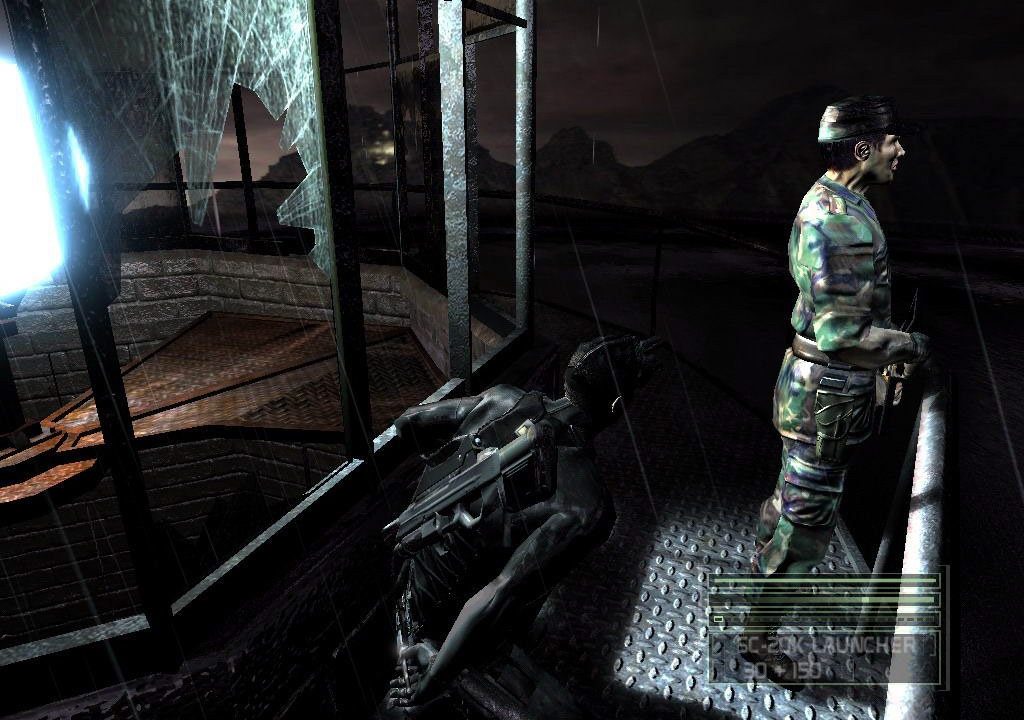
Thief: The Dark Project (1998) famously displayed a “light gem” on the HUD that brightened as Garrett became more visible. Tom Clancy’s Splinter Cell (2002) gave Sam Fisher a light meter that served the same role, and the player could shoot out lights or switch them off to create darkness. Splinter Cell: Conviction (2010) took a different approach, turning the screen to black and white when Sam was hidden in shadow, so the player could read visibility from the whole image.
Light-based systems create an interesting loop. Players reshape the level by changing the lighting, but enemies may notice that change. In many games, a guard who sees a light go out will investigate or try to turn it back on, which can itself become a distraction tool.
Not every stealth game emphasizes light this heavily. Hitman relies primarily on disguises and social behavior, and lighting has a much smaller role. Metal Gear Solid V considers factors such as time of day and camouflage, but it is not built around a single visibility meter the way Thief and the early Splinter Cell games are.
Sound and noise radius
Hearing is the second major sense. Most games model noise as a radius around its source: any guard inside the radius may hear it and react. Typical noise sources include:
- Footsteps, louder when running and quieter when crouching or walking slowly.
- Surfaces. Thief made this famous: metal and tile were loud, while carpet was quiet. Players could use moss arrows to soften a noisy floor.
- Combat and gunfire, usually the loudest sounds, often alerting large areas unless suppressed weapons are used.
- Thrown objects and gadgets, which create deliberate noise to lure guards.
- Environmental hazards, such as knocking over objects or breaking glass.
Splinter Cell: Chaos Theory (2005) added a sound meter that compared the noise Sam was making with the ambient noise level of the environment. In a loud area, such as near machinery, Sam could move faster without being heard. This is a good example of how detection systems can reward players for reading their surroundings.
Sound is also how many games handle distractions. Knocking on a wall in Metal Gear Solid or throwing a bottle in Dishonored creates a noise that draws a guard to a specific spot, pulling them out of position.
Alert states: from unaware to combat
Once an enemy notices something, the game needs a way to escalate and de-escalate its behavior. Most stealth games use a series of alert states. The names differ, but the pattern is consistent.
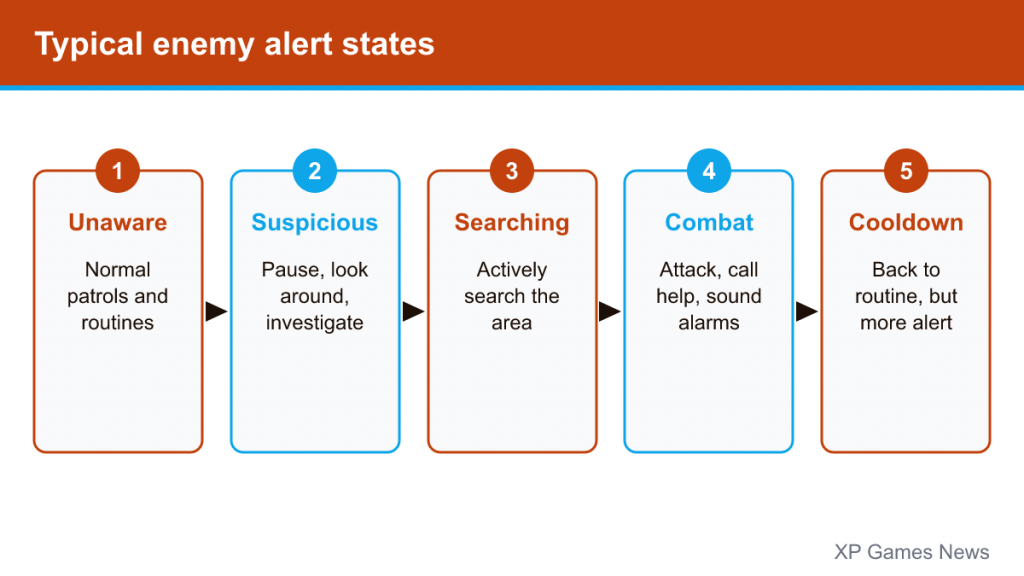
| State | What enemies do | How players typically respond |
|---|---|---|
| Unaware | Follow normal patrols and routines | Observe, plan, move between cover |
| Suspicious | Pause, look around, investigate a sound or a glimpse | Stay still, retreat, or use the investigation to slip past |
| Searching | Actively search the area, sometimes with more guards | Hide, relocate, wait for the search to end |
| Combat or alarm | Attack, call reinforcements, sound alarms | Fight, flee or break line of sight |
| Cooldown | Return to routines but often remain more alert | Resume, taking extra care |
The Metal Gear Solid series is well known for making these states explicit. The original games displayed an alert countdown, then evasion and caution phases as enemies searched and gradually calmed down. Metal Gear Solid V adapted this to its open-world design: after an alert, enemies at an outpost might remain on higher alert, and repeated tactics could lead to them adjusting their equipment over time, such as wearing helmets if you favored headshots.
Many games also include a “last known position” concept. In Splinter Cell: Conviction, a silhouette marked where enemies believed Sam was, and players could use that misconception to flank them. Other games represent this more subtly, with guards converging on the last place they saw you.
The cooldown state matters for fairness. If guards immediately return to normal, mistakes feel weightless. If they stay on maximum alert forever, one slip ruins the level. Most games find a middle ground, with guards becoming more watchful but eventually resuming routines.
Bodies, evidence and other triggers
Seeing the player directly is not the only way enemies become alert. Most stealth games include secondary triggers that indicate something is wrong:
- Bodies. An unconscious or dead guard discovered by another guard usually triggers a search or alarm. Hiding bodies in containers, dark corners or out-of-the-way rooms is a core stealth skill.
- Missing guards. Some games have enemies check in with each other. In Metal Gear Solid V, outposts can notice when a soldier fails to report, prompting an investigation.
- Cameras. Security cameras act as fixed vision cones. In Hitman, cameras record the player; if Agent 47 is caught on camera, destroying or erasing the recordings is required to keep a clean rating.
- Changed environment. Open doors, broken lights or disabled equipment can raise suspicion.
- Illegal actions and trespassing. In Hitman, being in a restricted area or seen doing something illegal, such as carrying a weapon openly or climbing through a window, draws attention even in disguise.
Body discovery in particular has a big influence on how players play. In Dishonored, guards that find bodies become alerted and search the area, and the chaos system tracks how many people the player kills. That combination nudges players toward non-lethal approaches and careful body disposal.
Disguises and social detection
Social stealth games add another layer: being seen is fine, as long as you look like you belong. Hitman’s disguises are the clearest example. Wearing a staff uniform lets Agent 47 walk through areas restricted to staff. However, certain non-player characters, known as enforcers, can see through specific disguises; a security chief might recognize that you are not one of their guards. Enforcers are marked with an indicator when Instinct mode is used, letting players plan around them.
The original Assassin’s Creed games used crowds and benches to hide the player and a notoriety system that made guards quicker to recognize you. Both are forms of social detection: the question is not whether you are visible, but whether you seem out of place.
Why games show you the system
Older stealth games could be opaque, leaving players to discover the rules through trial and error. Modern games tend to share more information through HUD indicators, sound cues and special vision modes:
- Hitman’s Instinct highlights targets, enforcers and important objects, and lets the player see through walls to track movement.
- Metal Gear Solid V’s marking lets players tag enemies with binoculars so their positions remain visible.
- Dishonored’s Dark Vision power shows enemies and their sight cones through walls.
- Splinter Cell’s goggles offer night vision and other vision modes to read the environment.
Some players prefer to turn these aids off for a harder, more immersive experience. Many games include options to reduce HUD elements or detection indicators for exactly that reason.
Common player mistakes
- Running everywhere. In most stealth games running is noisy and conspicuous. Walk or crouch when near enemies.
- Leaving bodies in the open. A single discovered body can turn a quiet level into a search.
- Ignoring cameras and enforcers. Guards are not the only watchers. Learn the secondary detection sources early.
- Panicking during suspicion. A suspicious guard is not yet alerted. Often the best move is to stay still or step back into cover.
- Assuming every game works the same way. Light matters enormously in Thief and early Splinter Cell, much less in Hitman. Learn each game’s priorities.
Understanding how detection works does not make stealth games easy, but it turns guessing into planning. Once you can read the signals, you stop feeling like the AI is cheating and start feeling like a professional who knows exactly how close to the edge they can walk.