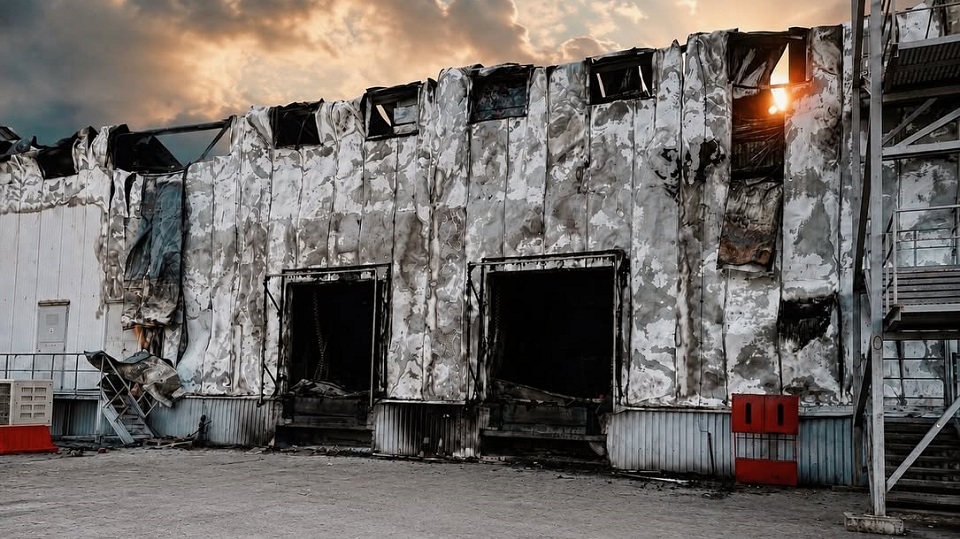
A recent Russian military strike has caused significant damage to commercial warehouses belonging to two major Ukrainian businesses, destroying a substantial portion of stored products. The attack targeted facilities operated by EKO Market, one of Ukraine’s prominent retail grocery chains, and Danube Agrarian, an agricultural company operating in the country’s southern regions. Despite the extensive material damage, officials confirmed that no workers were injured in the incident, offering a small measure of relief amid the destruction of valuable commercial inventory and infrastructure.
The strike represents another devastating blow to Ukraine’s civilian economic infrastructure, which has been systematically targeted since Russia launched its full-scale invasion in February 2022. EKO Market operates hundreds of stores across Ukraine, serving as a critical link in the country’s food distribution network. The damage to their warehouse facilities threatens to disrupt supply chains and could potentially affect food availability in the regions they serve, adding pressure to an already strained retail sector operating under wartime conditions.
Impact on Ukraine’s Agricultural and Retail Sectors
The attack on Danube Agrarian’s facilities is particularly concerning given the strategic importance of Ukraine’s agricultural sector to both the domestic economy and global food security. Ukraine has historically been one of the world’s largest exporters of grain and agricultural products, earning it the nickname “the breadbasket of Europe.” The Danube region, where the company operates, has become increasingly vital for Ukrainian grain exports following Russia’s blockade and repeated attacks on Black Sea port infrastructure. Companies operating in this area have faced continuous threats, yet they remain essential for maintaining Ukraine’s agricultural export capabilities.
The destruction of stored products at both facilities represents not only immediate financial losses for the companies involved but also broader implications for Ukraine’s food security and economic stability. Agricultural experts estimate that attacks on storage and logistics infrastructure have cost Ukraine billions of dollars since the beginning of the full-scale invasion. These strikes force companies to relocate operations, increase insurance costs, and create uncertainty that discourages investment in critical food production and distribution infrastructure.
Systematic Targeting of Civilian Infrastructure
This latest attack follows a well-documented pattern of Russian strikes targeting Ukraine’s civilian and commercial infrastructure. International observers and human rights organizations have repeatedly condemned these attacks as violations of international humanitarian law, which prohibits deliberate targeting of civilian objects. The Ukrainian government has documented thousands of such strikes on warehouses, food storage facilities, energy infrastructure, and other civilian targets since the war began. These attacks appear designed to weaken Ukraine’s economy and civilian resilience rather than achieve purely military objectives.
The fact that no workers were harmed in this particular incident is fortunate, though many similar attacks have resulted in civilian casualties. Ukrainian businesses have implemented various protective measures, including early warning systems, shelter protocols, and dispersed storage strategies to minimize both human and material losses. However, the continuous threat of aerial attacks makes normal business operations extraordinarily challenging and has forced many companies to fundamentally restructure their logistics and security approaches.
Economic Resilience and International Support
Despite the ongoing destruction, Ukrainian businesses have demonstrated remarkable resilience in maintaining operations and adapting to wartime conditions. EKO Market and other retail chains have continued serving customers throughout the conflict, often reopening stores within days of attacks and finding alternative supply routes when infrastructure is damaged. International partners and humanitarian organizations have provided support for rebuilding damaged commercial facilities, recognizing that maintaining civilian economic activity is essential for Ukraine’s long-term resistance and eventual recovery. The Ukrainian government has called for increased international pressure on Russia to cease attacks on civilian infrastructure and has sought additional air defense systems to protect critical economic assets from further destruction.
Expert Opinion: The systematic targeting of food storage and distribution infrastructure suggests a deliberate Russian strategy to undermine Ukrainian civilian morale and economic stability. As winter approaches and energy infrastructure remains vulnerable, protecting commercial supply chains will become increasingly critical. International donors should prioritize air defense systems for civilian infrastructure protection, as each successful defense prevents not only immediate destruction but also maintains the economic networks essential for Ukraine’s long-term resilience.